






Birupakshya Mahadev Patan: The Bhima Legend and the Sunken Statue
Birupakshya Mahadev in Patan: a sunken statue worshipped as both Shiva and the Pandava Bhima. Legends, location, festivals, and what to expect at Kwalkhu.

Birupakshya Mahadev Patan: The Bhima Legend and the Sunken Statue
The Birupakshya Mahadev shrine sits in south Patan, on the Kwalkhu side near the Bagmati, a short walk from Patan Durbar Square. The Nepali name Birupakshya comes from the Sanskrit Virupaksha, which properly means "odd-eyed" or "of unusual form" — an epithet of Shiva. Locally, though, the figure is almost universally called Bhima, the second Pandava brother known for his strength and appetite. The gap between the name on the shrine and the story people tell is not a mistake; it is a living tradition.
The Bhima Tradition: What Locals Say
Ask a priest or an elder in the lanes around Kwalkhu and you will hear that the image is Bhima, not Shiva. One version holds that the Pandavas passed through the valley during their exile and Bhima meditated here, his body slowly turning to stone. Another says Bhima knelt to drink from the Bagmati and the earth swallowed him up to his shoulders, leaving only his head and upper torso visible. A third telling links the site to the Mahabharata war: after the battle, Bhima came here to atone, and the statue marks the spot where his penance began. These are not fringe stories — they are the accounts you get when you stop and ask. The shrine's daily worship reflects this: mornings start with bel patra and milk offered to Bhima, and the priest will readily recount the Pandava connection if you have time to listen.
The Rising Image: Versions Told Side by Side
There is no single legend here, and that is the point. One widely shared version says the image rises slowly on its own, emerging a fraction each year from the sunken enclosure. Elders in Kwalkhu will tell you they have watched it lift over decades, though no one has produced a dated measurement. A second version insists the statue was deliberately sunk — or left partly buried — so it would never fully emerge. The prophecy attached to that telling is blunt: when the figure rises clear of the pit, the valley's current age will end. A third strand, repeated in older English guidebooks, claims a fixed annual rise of a few millimeters. That number appears without a source or a year, and no contemporary record confirms it. Treat it as a story, not a survey. The versions coexist because nobody in Patan feels the need to reconcile them.
Finding It: Kwalkhu, on the Bagmati Side
Head south from Patan Durbar Square toward the Bagmati. The shrine sits in a narrow courtyard just off the main lane that runs along the river's east bank at Kwalkhu. Look for a stone staircase descending into a square, sunken enclosure — about three meters deep — with the statue's head and broad shoulders centered at the bottom. There is no signboard in English. A small metal trident marks the entrance, and a resident priest is usually present during morning and evening puja (roughly 6–8 am and 5–7 pm). The courtyard is tight; you stand on the top step and look down. Photography is permitted only with the priest's okay — ask first. The site is busiest on Shivaratri and during the local Bhimsen Jatra in late autumn, when the enclosure fills with marigold garlands and oil lamps.
What You Actually See
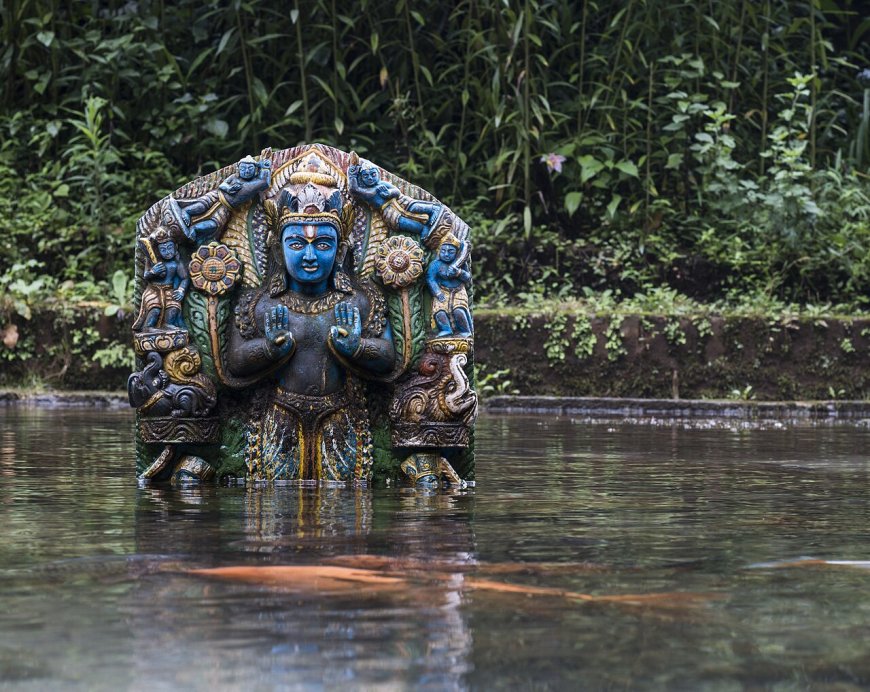
A large rock-cut male figure, shoulders broad, face calm, eyes half-closed. Only the head, neck, and upper chest rise above the enclosure floor. The stone is dark grey, worn smooth by decades of abhishek. A few worn steps lead down to a narrow walkway circling the base, though visitors rarely descend — the viewing is from above. There is no mandir roof, just the open sky and the sound of the Bagmati a few dozen meters away. If you have seen the Pashupati lingam, this feels different: older, quieter, and entirely rooted in a story that refuses to choose between god and hero.
What's Your Reaction?