






Reading Your Nepal Electricity Bill: Meter Reading, Slabs and Demand Charge Explained
A line-by-line walk through a real, anonymised NEA bill in Nepal: how billed units come from two meter readings, why slab rates are marginal rather than flat, what demand charge has to do with connected load, and how to recompute your own total.

Last reviewed: September 2026. Rates change; the mechanism does not. This explainer is written so it stays accurate even after a tariff revision, and should be re-checked whenever NEA or the ERC publishes a new schedule.
What an NEA bill actually is
A monthly NEA bill is not a record of what you switched on. It is a record of how far the meter's cumulative register moved between two reading dates, multiplied through a tariff schedule that NEA publishes but does not set alone. Under the Electricity Regulatory Commission Act, retail tariff revisions for NEA and other licensees go through the ERC. So when a rate appears, the correct attribution is the NEA tariff schedule approved by the ERC, in force from the effective date printed with it. Confirm the schedule currently in force at nea.org.np or in the ERC's own publications.
The sample bill, line by line
The example used here is an anonymised domestic single-phase bill. Name, address, consumer number, meter number, QR code and payment reference have all been removed, because consumer numbers are traceable back to a household. Not every bill carries every line: single-phase domestic, three-phase domestic, non-commercial, commercial, industrial, irrigation and community tariffs have different structures, and meter types differ.
Each bill carries consumer name and address, consumer number, meter number and meter type, tariff category and phase, billing month with the reading date range, previous reading, current reading, billed units, then the charge lines, and finally the issue date and due date.
Meter reading vs billed units
Billed units are a subtraction, not a measurement of your appliances. The meter register climbs like an odometer and the bill subtracts last month's figure from this month's. On the sample bill: previous reading 14,208, current reading 14,520, billed units 312. Some meter types carry a multiplier that is applied to the dial difference before it becomes billed units.
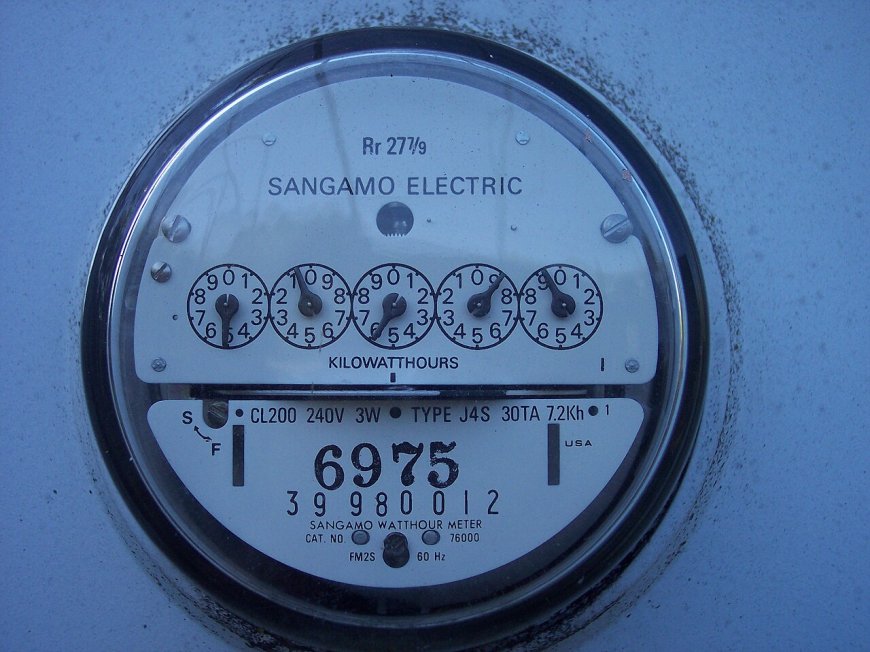
Digital LCD meters cycle through several displays; the cumulative kWh register is the one that only ever goes up. Older dial meters are read dial by dial. When a meter cannot be read, for a locked gate, access problem or fault, NEA may bill an estimate that is later trued up against an actual reading, which is why an estimated month can look wrong. A simple check for a creeping meter is to switch everything off and see whether the register still moves. If a pattern looks persistently impossible, report it to your distribution centre. Do not open, bypass or interfere with the meter; tampering is an offence.
The slab mechanism, and the mistake almost everyone makes
Domestic billing is marginal, not flat. The first block of units is charged at a lower rate, the next block higher, and so on. Your 312 units are split across bands, not multiplied by the top rate. This is the single most common error in reading a Nepali bill.
Worked arithmetic
Use the bands printed on your own bill. The rates below are letters, not figures.
Band 1: first 20 units × Rate A
Band 2: next 30 units × Rate B
Band 3: remaining 262 units × Rate C
With illustrative rates only, and these are not current rates, say Rs 5, Rs 8 and Rs 11, that gives 100 + 240 + 2,882 = Rs 3,222 of energy charge. Add the demand charge (illustrative Rs 150), meter rent (illustrative Rs 30) and any service or fixed charge, subtract any prompt-payment rebate, add any late fee if an earlier bill went unpaid, and you have the total. Duty or adjustment lines appear on some categories.
Demand charge and connected load
Demand charge is a capacity charge, separate from the energy charge. It relates to the load you have connected, or to the maximum demand drawn, depending on tariff category and metering arrangement. Connected load is measured in kW (kVA in some cases); maximum demand is the peak actually drawn. That is why two homes with identical units can pay different totals: different connected load, phase or category. Three-phase and larger non-domestic consumers are more likely to see this line, and for some categories it applies even in a month of near-zero consumption. Whether the basis is per kW connected, per kVA or per kW of maximum demand varies, so check the current schedule.
Meter rent, service charges and duty lines
Meter rent is a fixed monthly amount for the meter itself, not for electricity. Service or fixed charges recover connection and administrative cost. Duty, adjustment or subsidy lines appear on some bills and categories and not others. None of these move with your units.
Due date, rebate and late payment
Every bill prints an issue date and a due date. Paying within the stated window may attract a rebate; paying after it may attract a late-payment amount, and continued non-payment can lead to disconnection, a reconnection charge and a security deposit requirement. Treat the printed due date as authoritative and ask your distribution centre about the current percentages, grace periods and fees.
Recompute your own bill
Write down the previous reading, current reading, the difference and any multiplier. List each slab band and how many of your units fall into it, multiply, then sum. Add demand charge, meter rent, service charge and duty. Subtract any rebate. Compare the figure with the printed total. A small gap usually means one line was skipped.
If the bill looks wrong
Recompute the units from the printed readings first. Then check the tariff category and phase on the bill against what is actually installed, then the connected load. Take it up with your local NEA distribution centre, and if it stays unresolved use the consumer grievance route; the ERC has a consumer-facing grievance role. Confirm the current complaint steps and timelines with the distribution centre or the ERC.
Where to confirm current rates
nea.org.np publishes the approved schedule, and the ERC publishes its own determinations with effective dates. Trust the effective date over any undated rate table you find online, including older versions of explainers like this one.
The short version
Units come from subtracting two readings. Slabs are marginal, so your units split across bands. Demand charge is about capacity, not consumption. Everything else, meter rent, service charge, duty, rebate and late fee, sits around those two core numbers. Recompute once with your own bill and the format stops being mysterious.
What's Your Reaction?