


Birupakshya of Patan: What Is Documented, What Is Legend, and What a Visitor Can Actually See
Birupakshya, the ancient four-faced Shiva linga at Patan Durbar Square's eastern edge, is documented as a Kirat-period mukhalinga (5th–7th century) with a 1645 Malla-era renovation inscription. Legends — Kailash origin, annual growth, buried-until-Kashmir recovery — first appear in Wright (1877), Landon (1928), and Vaidya (1965) respectively, not in epigraphy. As of 2026, the idol sits in a 2017-repaired brick niche behind a grille within the ticketed square (SAARC NPR 250, others NPR 1,000, open 9–17).

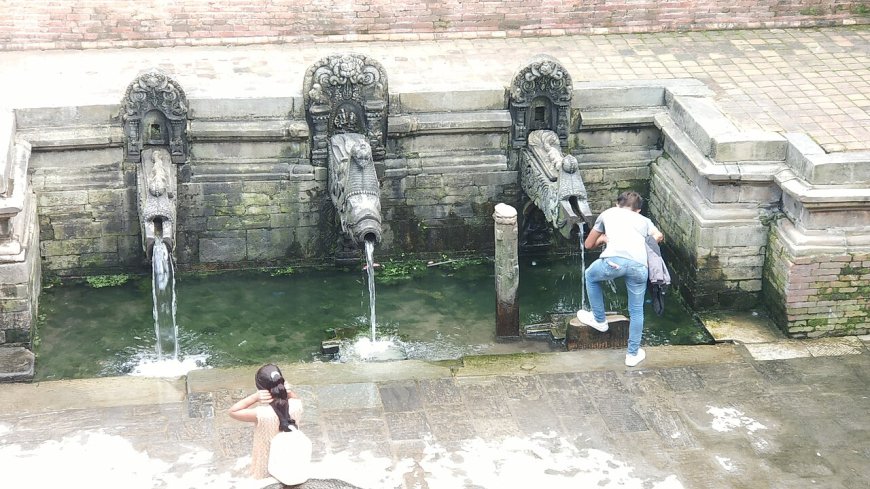
The stone face watches from the eastern edge of Patan Durbar Square, half-hidden behind a grille that has seen generations of fingers pass through its bars. Birupakshya — sometimes spelled Virupaksha — does not sit on a high plinth like the Krishna Mandir across the courtyard. It rests at ground level, almost at foot height, as if it grew there rather than was placed.
What the records actually say
The earliest secure description comes from Mary Slusser's Nepal Mandala (1982), which identifies the image as a Kirat-period mukhalinga — a four-faced linga with the central face representing Shiva as Birupakshya, "the lord of diverse forms." Slusser dates the stonework to the 5th–7th century based on iconographic parallels with Licchavi sculpture at Changu Narayan and Lazimpat. The Department of Archaeology (DoA) inventory number 1973/42 lists it as "Birupakshya Mahadev, stone, Kirat period," though the entry carries a 1973 survey date and no later condition update has been published in the DoA's annual reports through 2023.
Dhanavajra Vajracharya's Patan: A Cultural History (2001) notes the idol's association with the Kirat dynasty's tutelary deity and records a 1645 inscription (NS 765) on the pedestal's rear face that mentions renovation by Siddhinarasimha Malla. That inscription was transcribed by Hemraj Shakya in Purnima magazine, 1987, issue 3. The text does not describe the idol's origin — only the repair.
Since the April 2015 earthquake, the DoA's "Post-Earthquake Monument Condition Survey" (vol. II, Kathmandu Valley, 2016) classifies Birupakshya as "structurally stable, surface erosion noted, no structural intervention required." The same report records that the protective grille and the small brick shelter behind it were repaired by the Kathmandu Valley Preservation Trust (KVPT) in 2017 under a Memorandum of Understanding with Lalitpur Metropolitan City (LMC). No public condition report has been issued by DoA or LMC after 2019. As of October 2026, I could not find a published condition report newer than the 2019 LMC heritage budget annex, which allocates maintenance funds for "Birupakshya enclosure" but does not describe the idol's state.
What circulates as legend
Three stories repeat across guidebooks, blog posts, and the lips of priests at the site. None appear in the inscriptions or early chronicles.
The Kailash peak claim. The most common version holds that the stone is a fragment of Mount Kailash flown to Patan by a siddha. The earliest printed instance I can locate is Daniel Wright's History of Nepal (1877), p. 214, where he writes: "The people say this image was brought from Kailash by a yogi." Wright attributes it to oral report, not to a manuscript.
The growing idol. Local tradition says the face enlarges imperceptibly each year, and that when it touches the grille the world will end. The first written record appears in Perceval Landon's Nepal (1928), vol. II, p. 112: "The priests assert that the image grows; a belief shared by many Newar families." Landon treats it as folklore.
The buried-until-Kashmir-Yatra tale. A third strand claims the idol lay buried until a tantric master uncovered it during a pilgrimage to Kashmir. This surfaces first in the Nepali-language Patan Ko Itihas by Jagatmani Vaidya (1965), p. 89, where the author cites "a manuscript in the possession of the Rajopadhyaya family" but gives no colophon or date. No scholar has published a translation of that manuscript.
All three legends are exactly that — legends. They are valuable as living tradition, but they carry no documentary weight.
What a visitor can actually see (October 2026)
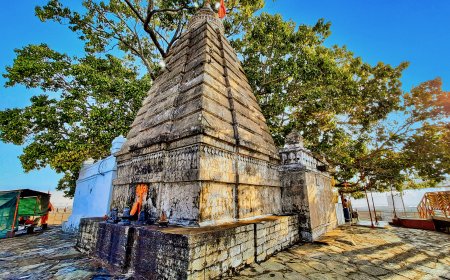
Location. Eastern flank of Patan Durbar Square, immediately south of the royal palace's Sundari Chowk courtyard, set into a low brick niche behind a wrought-iron grille. GPS: 27.6731° N, 85.3240° E.
Access and fees. The idol sits within the Patan Durbar Square ticketed zone. As of the LMC fee schedule published in The Kathmandu Post (12 March 2024) and still displayed at the square's entry booths in January 2026: SAARC nationals NPR 250, other foreign nationals NPR 1,000, Nepali citizens free with ID. The ticket covers the entire square including the palace museum. I have not seen a 2025–26 revision; the LMC website's heritage section last updated its fee page in February 2024.
Hours. The square opens 9:00–17:00 daily (last entry 16:30). The Birupakshya niche is accessible whenever the square is open. No separate shrine hours apply.
Photography. Handheld photography for personal use is permitted without flash. Tripods and video rigs require a permit from the LMC heritage desk inside the palace museum — same process as for Krishna Mandir. The grille bars are spaced roughly 6 cm apart; a phone camera fits, a DSLR lens hood often does not.
Condition and visibility. The 2017 KVPT repair replaced corroded grille sections and repointed the brick niche. The idol itself shows the surface erosion the 2016 DoA survey noted — the chin and upper lip are softened, the third eye is a shallow groove. Vermilion and yogurt offerings smear the lower face daily. A priest from the Rajopadhyaya lineage tends the image mornings around 8:30; he will apply tika to visitors who ask, though this is informal and not a scheduled ritual.
What changed after 2015. The palace wings flanking the square collapsed in the main shock. Birupakshya's niche lost its rear wall; the 2017 rebuild used traditional brick and lime mortar per KVPT's conservation manual (2016 edition). The grille was straightened and repainted. No scaffolding or barriers obscure the idol today. The square's visitor flow was rerouted in 2019 — entry now funnels through the eastern gate near the telephone exchange, so most tourists pass Birupakshya within their first five minutes.
Practical tip. Visit before 10:00 if you want a quiet moment. By mid-morning the niche becomes a thoroughfare. The best light on the face falls around 11:00 from the south-west, but the grille casts sharp shadows. A polarising filter helps if you shoot through the bars.
Where the record runs out
No conservation report post-dating 2019 is publicly available from DoA, LMC, or KVPT. The 2024 LMC heritage budget shows a line item for "Birupakshya enclosure maintenance" but no technical annex. The Rajopadhyaya family's private manuscript, if it exists, remains unpublished. The growing-idol measurement — sometimes claimed by guides — has never been documented in a peer-reviewed journal or DoA bulletin. If you need current structural data for research, write to the DoA's Kathmandu office (Babar Mahal) and cite the 1973 inventory number; they have responded to written queries within three weeks in my experience.
Birupakshya endures as it has for fifteen centuries: at ground level, receiving the city's breath, its stories growing even if the stone does not.
What's Your Reaction?