




Number Plate Colours and Codes in Nepal: What Each Colour Means
What each vehicle number plate colour means in Nepal — red for private, black for public, white for government, green for tourist, yellow for national corporations and blue for diplomatic vehicles — plus how to read a plate such as Ba 1 Pa 1234.
Updated September 2026: the plate colours and codes on this page were corrected and checked against published references. An earlier version listed several colours incorrectly.
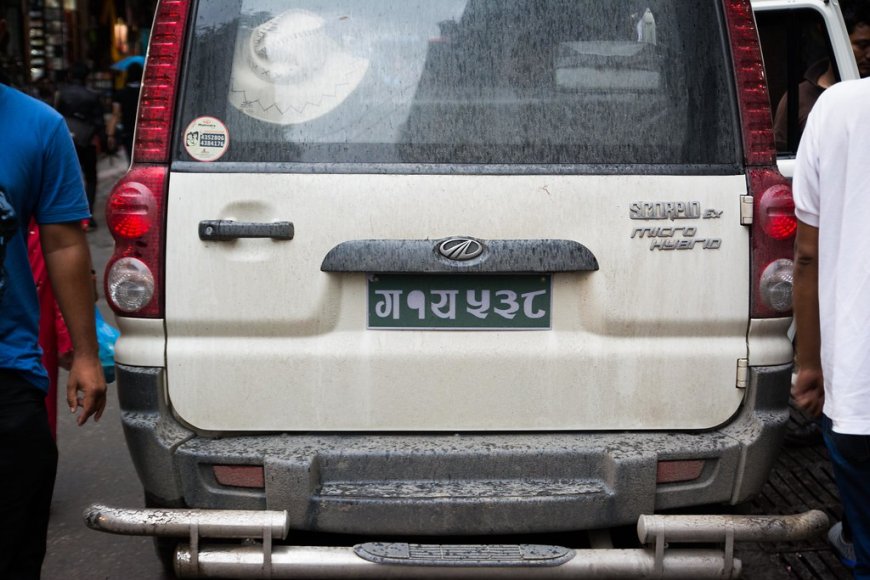
In Nepal, a vehicle's number plate tells you more than its registration number. Its colour shows who the vehicle belongs to — a private owner, a public transport operator, the government, a national corporation, a diplomatic mission or a tourist operator — and on the older plates, its letters show the zone where it was registered and the vehicle's size and category.
Number plate colours in Nepal at a glance
| Plate colour | Letter colour | Vehicle type |
|---|---|---|
| Red | White | Private vehicle (personal use) |
| Black | White | Public vehicle (buses, taxis, goods carriers for hire) |
| White | Red | Government vehicle (ministries, departments, police, constitutional bodies) |
| Yellow | Dark (usually black, sometimes blue) | National corporation (e.g. Nepal Telecom, Nepal Electricity Authority) |
| Blue | White | Diplomatic vehicle (embassies, consulates, missions) — code सी.डी. (C.D.) |
| Green | White | Tourist vehicle (travel agencies, hotels) |
How to read an older plate, such as "Ba 1 Pa 1234"
The older (pre-embossed) format has four parts:
- Zone code — the zone where the vehicle was registered, e.g. बा (Ba) for Bagmati.
- Lot number — a 1–2 digit number that increases when the four-digit serials run out.
- Category letter — shows the vehicle's size and ownership type (see the table below).
- Serial number — four digits issued in sequence.
So "Ba 1 Pa 1234" is a private two- or three-wheeler from Bagmati zone, lot 1, serial 1234. "Ba 1 Ba" would be a government two- or three-wheeler from Bagmati zone.
Category letters
| Ownership | Heavy / medium vehicle | Light vehicle | Two / three-wheeler |
|---|---|---|---|
| Private | क (Ka) | च (Cha) | प (Pa) |
| Public | ख (Kha) | ज (Ja) | फ (Pha) |
| Government | ग (Ga) | झ (Jha) | ब (Ba) |
| Diplomatic | सी.डी. (C.D.) | सी.डी. (C.D.) | — |
| Tourist | य (Ya) | य (Ya) | य (Ya) |
| National corporation | घ (Gha) | ञ (Nya) | — |
Zone codes
Nepal's 14 former zones (dissolved in 2015) each had a code that still appears on older plates:
| Zone | Code | Zone | Code |
|---|---|---|---|
| Mechi | मे (Me) | Gandaki | ग (Ga) |
| Kosi | को (Ko) | Lumbini | लु (Lu) |
| Sagarmatha | स (Sa) | Dhawalagiri | ध (Dha) |
| Janakpur | ज (Ja) | Rapti | रा (Ra) |
| Bagmati | बा (Ba) | Bheri | भे (Bhe) |
| Narayani | ना (Na) | Karnali | क (Ka) |
| Seti | से (Se) | Mahakali | म (Ma) |
The newer embossed provincial plates
A new plate format was introduced in 2017 to replace the zone-based system with provinces. These plates are embossed, black on white, written in Latin letters, carry an RFID chip, and have a strip on the left with the national flag and the letters NEP. Their format is PROVINCE X AB 0123, where X is a letter showing the vehicle class (for example A for motorcycles and scooters, B for cars, jeeps and vans). The rollout was interrupted by a Supreme Court order following a petition, so both the older coloured plates and the newer embossed plates can be seen on Nepal's roads.
Why number plates matter
Identification and regulation: number plates let authorities identify vehicles and check that they are registered and compliant. Revenue: registration links each vehicle to its owner so that taxes and fees are collected. Road safety: identifiable vehicles make traffic enforcement and accident response possible. Public awareness: the colour of a plate tells anyone at a glance whether a vehicle is private, public, government, corporate, diplomatic or tourist.
FAQs about number plates in Nepal
1. What does a red number plate mean in Nepal?
A red plate with white letters is a private vehicle — cars, jeeps and motorcycles registered for personal use.
2. What does a black number plate mean in Nepal?
A black plate with white letters is a public (commercial) vehicle, such as a bus, taxi or goods carrier used to transport people or goods for hire.
3. What does a white number plate mean in Nepal?
On the older plates, a white plate with red letters is a government vehicle, including vehicles of ministries, departments, the police and constitutional bodies. The newer embossed provincial plates are also black on white, so check the format: the new plates use Latin letters and carry the word NEP beside a national flag strip.
4. What does a yellow number plate mean in Nepal?
A yellow plate with dark (usually black, sometimes blue) letters belongs to a national corporation — a public corporation fully or partly owned by the government, such as Nepal Telecom or the Nepal Electricity Authority.
5. What does a blue number plate mean in Nepal?
A blue plate with white letters is a diplomatic vehicle registered to a foreign embassy, consulate or mission. These plates use the code सी.डी. (C.D.).
6. What does a green number plate mean in Nepal?
A green plate with white letters is a tourist vehicle, registered to a travel agency or hotel for carrying tourists.
7. What does "Ba 1 Pa 1234" mean on a Nepali number plate?
On the older format, "Ba" (बा) is the Bagmati zone code, "1" is the lot number, "Pa" (प) means a private two- or three-wheeler, and 1234 is the vehicle's serial number. A plate reading "Ba 1 Ba" uses ब (Ba) as the category letter, which marks a government two- or three-wheeler.
8. Who issues vehicle number plates in Nepal?
Plates are issued through the provincial Transport Management Offices, under the Department of Transport Management (DoTM).
Sources: the Vehicle & Transport Management Act 2049 (1992) and Rules 2054 (1997) classification as summarised in Vehicle registration plates of Nepal. For your own vehicle, confirm with your provincial Transport Management Office or the Department of Transport Management.
What's Your Reaction?








Learner, love to explore things and ideas.

-
 Car HamroLoved reading your article. Wish to see more in the coming days.