















Open‑Source AI Tools Every Nepali Startup Should Use in 2025
A guide for Nepali startups on using free AI tools to build products in 2025.

Open‑Source AI Tools Every Nepali Startup Should Use in 2025
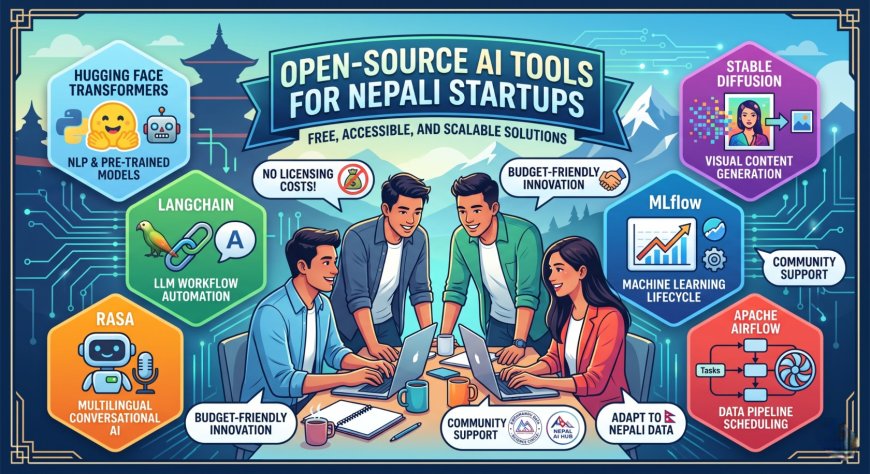
If you are building a startup AI solution in Nepal, the good news is that there are many open source AI tools you can use at no licensing cost. These free platforms let you experiment, prototype, and scale without breaking the bank, and they integrate smoothly into a machine learning workflow for startups.
Why Open‑Source AI Matters for Nepali Startups
Open‑source software removes the biggest barrier for early‑stage companies: price. A recent survey of South Asian founders indicated that cost is a primary reason many avoid AI services. By using community‑maintained models you can keep cash flow healthy while still accessing advanced technology.
Budget‑Friendly Innovation
Because the code is free, you can allocate budget to hardware, talent, or marketing instead of software licences. The community also provides frequent updates, meaning you stay current without paying for a vendor upgrade.
Top Practical Open‑Source AI Tools
Hugging Face Transformers
This library hosts thousands of pre‑trained models for natural language processing, image classification, and more. You can fine‑tune a model on Nepali text data and deploy it via a simple API. Repository: github.com/huggingface/transformers.
LangChain
Designed for chaining calls to language models, LangChain helps you build chatbots, automated reporting, or workflow automation. It works well with Hugging Face models and is ideal for startup AI prototypes. Repository: github.com/langchain-ai/langchain.
Rasa
Rasa is an open‑source framework for building conversational agents without writing code from scratch. It supports multilingual pipelines, so you can train a Nepali‑language bot using local datasets. Repository: github.com/rasa/rasa.
Stable Diffusion
For visual content such as marketing graphics or product mockups, Stable Diffusion lets you generate high‑quality images locally. Its lightweight variants run on modest cloud instances or even on‑premise servers. Repository: github.com/Stability-AI/stable-diffusion.
MLflow
Tracking experiments, packaging models, and managing deployments is easier with MLflow. It integrates with many other tools and can be hosted on a cheap VPS. Repository: github.com/mlflow/mlflow.
Apache Airflow
If your startup needs to schedule data pipelines, Airflow’s DAG system automates ETL jobs, model retraining, and reporting tasks. It runs on a single server and scales as you grow. Repository: github.com/apache/airflow.
Step‑by‑Step Implementation Guide
Assess Business Needs
Start by listing the problems you want AI to solve – customer support, content generation, image creation, or process automation. Rank them by impact and required data volume.
Choose the Right Tool
Match each need to a tool from the list above. For example, use Hugging Face for NLP tasks, Stable Diffusion for image generation, and Airflow for scheduled data jobs.
Set Up Low‑Cost Environment
Pick a cloud provider that offers a low‑cost tier. AWS’s free tier is limited to 12 months, and DigitalOcean does not have a free tier; consider services such as Hetzner, Linode, or AWS Lightsail for affordable instances. A single‑vCPU instance with 2 GB RAM works well for small or quantized models, but larger or full‑size models may need more memory.
Adapt Models to Nepali Data
Collect publicly available Nepali text or image datasets, or create your own small corpus. Fine‑tune a transformer model on this data, then test accuracy with a held‑out set. Community forums on Hugging Face and Rasa have discussion threads that can help you troubleshoot.
Iterate with Community Support
Join local meetups such as the Kathmandu Data Science Circle or the Nepal AI Hub. These groups share tutorials, code snippets, and debugging tips, making the learning curve far less steep.
Overcoming Connectivity and Budget Constraints
Limited internet bandwidth is a common hurdle. To stay offline‑first, download model checkpoints once and run them locally. Use quantized or distilled versions of large models – they are smaller and faster, which reduces data usage and hardware cost. The Hugging Face Hub offers “optimum” models that are optimized for low‑resource environments.
Documentation in Nepali is still scarce, but several open‑source projects now publish guides in the local language. For instance, the Rasa community provides multilingual resources, and you can find Nepali‑language tutorials on the Rasa forum: forum.rasa.com.
Resources and Further Learning
Here are some handy links to get you started:
- Hugging Face Transformers – github.com/huggingface/transformers
- LangChain – github.com/langchain-ai/langchain
- Rasa – github.com/rasa/rasa
- Stable Diffusion – github.com/Stability-AI/stable-diffusion
- MLflow – github.com/mlflow/mlflow
- Apache Airflow – github.com/apache/airflow
- AI Adoption Survey 2024 – South Asia – AI Adoption Survey 2024 – South Asia
- Kathmandu Data Science Circle – meetup.com/kathmandu-data-science/
- Nepal AI Hub – nepalai.org
By leveraging these open source AI tools, Nepali startups can build robust, scalable products without licensing fees, stay competitive in a fast‑moving market, and contribute back to the growing regional AI community.
What's Your Reaction?