



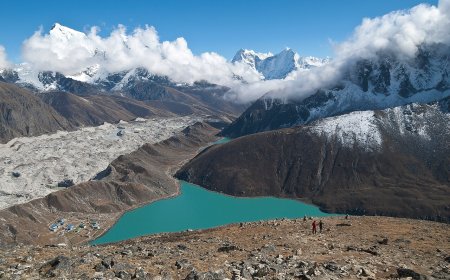

Manaslu: the 8,163 m Peak, Mansiri Himal and Conservation Area
Manaslu is the 8,163 m peak of the Mansiri Himal in northern Gorkha, seventh-highest in Nepal and eighth in the world, and the mountain at the centre of the 1998-gazetted Manaslu Conservation Area. A record-and-disambiguation page covering the competing height figures, the range's other peaks, the 1956 Japanese first ascent and the protected area, with trek logistics deliberately left to the travel guides section.

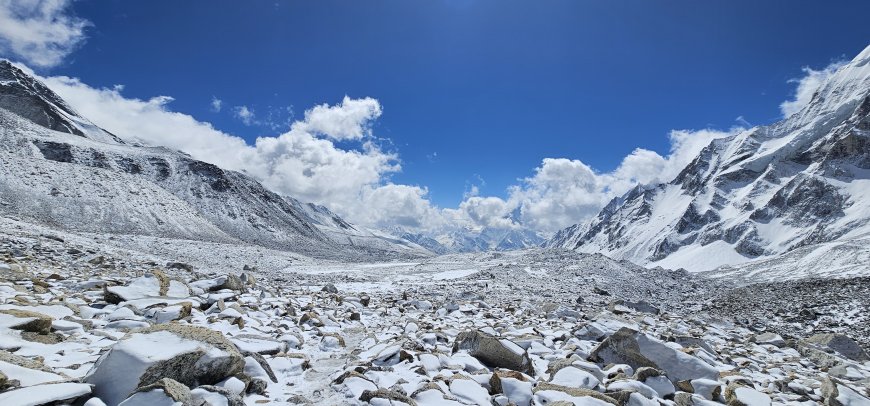
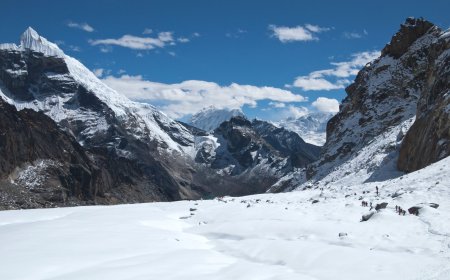
Manaslu is the 8,163 m peak at the centre of two rings: the Mansiri Himal it tops, and the Manaslu Conservation Area that wraps around it. It is the seventh-highest mountain in Nepal and the eighth-highest in the world, and most of what gets written about it is trip planning. This page is the record instead: the mountain, the range it belongs to, the protected area that contains it. Not a route guide. Permits, seasons, costs and itineraries are deliberately out of scope — the Manaslu Circuit trek write-up lives in our travel guides section, and this article does not repeat it.
Where Manaslu sits
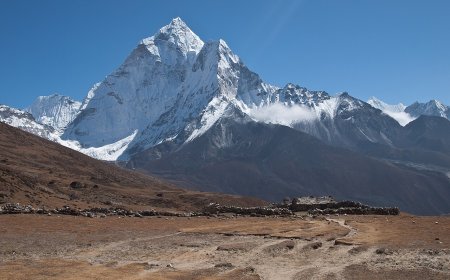
Manaslu stands at 8,163 m in the Mansiri Himal, a sub-range of the Nepal Himalaya in northern Gorkha district. Eighth-highest in the world, seventh in its own country: Everest, Kangchenjunga, Lhotse, Makalu, Cho Oyu and Dhaulagiri I all stand higher, and only Annapurna I among Nepal's eight-thousanders is lower. That ranking is worth stating plainly, because Manaslu is an eight-thousander without being a famous one. Ask a room to name Nepali 8,000 m peaks and you will get Everest, Annapurna, maybe Dhaulagiri. Manaslu usually comes later.
The administrative label needs a note. Older sources place Gorkha in the Gandaki Zone, and you will still see that in print. Nepal's zones were replaced by provinces under the 2015 constitution, and Gorkha now falls within Gandaki Province. Both statements were accurate for their period; only one is current.
Why the height figure moves
Manaslu's height is given as 8,163 m in current reference works. Pre-1990s gazetteers and older climbing literature often list 8,156 m, or 26,759 ft in imperial tables. The gap is not an error anyone needs to be scolded for. Summit heights shift with survey method, with the datum a survey is reduced to, and in Manaslu's case with the snow and ice cap sitting on top of the rock summit — a distinction that matters more on a heavily glaciated peak than on a dry one. Treat the lower figure as a historical measurement rather than a wrong one, and 8,163 m as the working number.
The Mansiri Himal, peak by peak
Manaslu is the highest member of its range by a clear margin, but it is not alone in it.
| Peak | Height | Note |
|---|---|---|
| Manaslu | 8,163 m | Highest in the Mansiri Himal; eighth-highest in the world, seventh in Nepal |
| Himalchuli | 7,893 m | Second-highest in the range |
| Ngadi Chuli (Dakura) | 7,871 m | Third-highest in the range |
Ngadi Chuli carries two names in common use. Dakura appears in older mountaineering accounts, Ngadi Chuli in most modern ones, and readers following a route description from the 1970s should expect the first.
The 1956 first ascent
The summit was reached on 9 May 1956 by Toshio Imanishi and Gyalzen Norbu Sherpa, members of a Japanese expedition led by Yuko Maki. The line they climbed was the north-east face, approached through the upper Budhi Gandaki. Those are two different things and worth keeping apart: the river drains to the east and north-east of the summit, so the valley is the way in, not the face itself.
That ascent is the point on which the mountain's modern history turns, because the Japanese effort was not a single lucky push. A reconnaissance party had looked at Manaslu in 1950, and formal attempts followed in 1952, 1953, 1954 and 1955 before the 1956 team found a line that held.
Fourteen years later, Reinhold Messner was on Manaslu with his brother Günther. Günther died on the mountain during that 1970 expedition, and the circumstances of his death have been argued over in climbing literature ever since. It is a climbing-history footnote rather than a Manaslu record item, but leaving it out would make the record incomplete.
What the name means
The usual explanation traces Manaslu to the Sanskrit manasa, meaning mind, intellect or soul, so something like "mountain of the spirit." Do not treat that as settled. Competing derivations circulate, and none of them is documented well enough to close the question. The Sanskrit reading is worth knowing; it is not worth presenting as the final answer.
The Manaslu Conservation Area
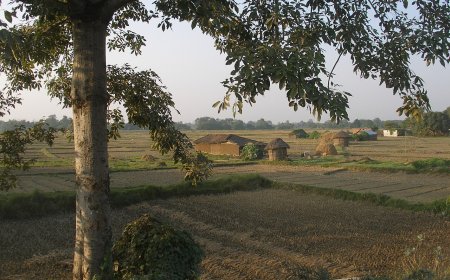
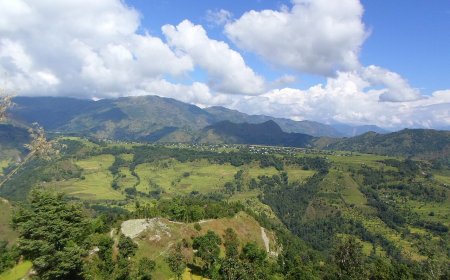
Around the mountain lies the Manaslu Conservation Area, gazetted in 1998 and covering roughly 1,663 km² of northern Gorkha. It is administered by the National Trust for Nature Conservation under the Department of National Parks and Wildlife Conservation. In outline the area follows the upper Budhi Gandaki and its side valleys up to the Tibetan border, taking in the dry, high, sparsely forested trans-Himalayan country that feels nothing like the green hills further south. Inside it sits a Bhotia agro-pastoral landscape, with terraced fields, herding pastures and villages that predate the protected status by a very long time.
One clarification, because the two things get muddled constantly: the conservation area is a protected area around a mountain, not a trekking product. Its boundaries, its managing body and its designation year are geography and conservation facts. Anything about access, fees or paperwork attached to walking through it belongs to a different kind of article.
Where this leaves the record
An 8,163 m peak, eighth in the world and seventh at home, highest in the Mansiri Himal, climbed in 1956 after attempts in 1952, 1953, 1954 and 1955, sitting inside a protected area gazetted four decades later. That is the short version. For the range as a whole, the mountains hub is the place to start; for the district around it, see Gorkha.
What's Your Reaction?