












How Hard Is Ama Dablam? Route Grades and Real Risks
Ama Dablam is graded AD and stands at 6,812 m. Here is what that grade leaves out: altitude, exposure, rope queues and narrow weather windows.

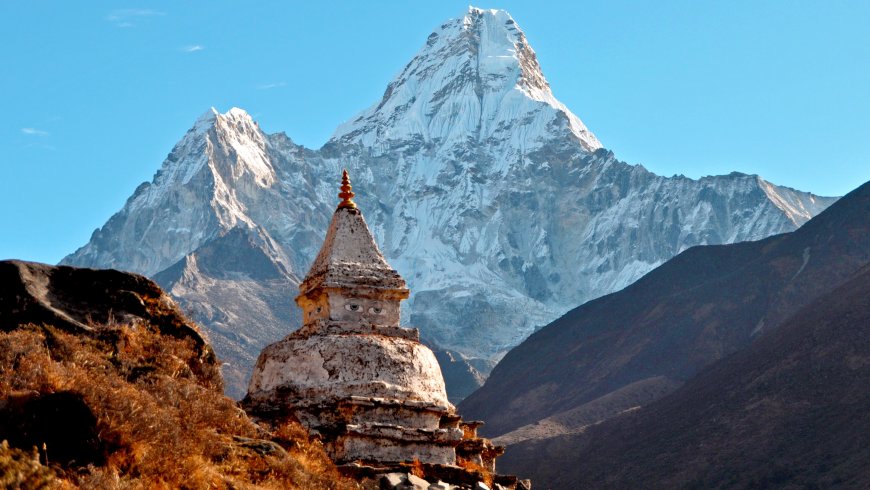
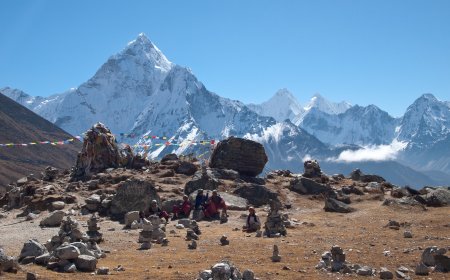
From the trail up the Dudh Kosi, Ama Dablam does not look like something you climb. It looks like something stood on end: a narrow triangle of rock and ice with a summit that seems to lean out over the valley. That silhouette is why people stop walking, point at it, and ask the same question. How hard is it, really?
The short answer is that Ama Dablam is hard, and the word is doing a lot of hiding. “Hard” gets used for at least four different things here: technical difficulty, altitude, sustained exposure, and the plain business of getting up and back down before the weather turns.
What the mountain actually is
Ama Dablam stands at 6,812 m in the Khumbu, southeast of Everest and directly above the Dudh Kosi. It was first climbed in 1961 by the Southwest Ridge, and that same line is still the route nearly everyone uses today.
It is frequently compared to the Matterhorn, mostly because of the shape, and because both are steep, photogenic peaks that attract people moving up from easier ground. In the Himalaya that move matters. Island Peak is generally treated as a first big objective, with Lobuche East playing a similar role a ridge or two away. Ama Dablam is the one after that.
Most of the climbing happens from high camp on the ridge, on steep snow and rock where much of the hardest ground is fixed with rope. Above that, the angle stays on and the exposure does not let up until you are on the top. The descent follows the same line. There is no walk-off and no section where you can switch off.
The grading problem: there is no single number
Ask five climbers to grade Ama Dablam and you will get five systems back, because no single authoritative grade for the mountain exists. Each system is answering a different question.
| System | What it measures | Where Ama Dablam usually lands | What it leaves out |
|---|---|---|---|
| Alpine grades (PD, AD, D) | The route as a whole: length, steepness, technical demand | Generally placed in the AD band, meaning steep and sustained with real technical ground | Altitude, traffic, and how you personally cope above 6,000 m |
| French rock and ice grades | The difficulty of individual pitches | Relevant only to short steps, since much of the steep ground is climbed on fixed rope | Almost everything about the climb as a day out |
| Commitment grades (Roman numerals, Alaska-style) | How remote and self-reliant the route is | Modest for a Himalayan peak: close to base camp, well travelled, ropes in place | Technical difficulty, and what a slip would cost you |
| Operator labels (“introductory”, “intermediate”, “advanced”) | The fit between a paying client and a trip | Inconsistent. The same mountain gets sold as a first technical 6,000er and as a serious step up | Any standard measurement. Marketing is not grading |
Read together, the table explains why the difficulty conversation goes round in circles. A climber who says “it's AD” is describing the route. An operator calling it a first technical 6,000 m peak is describing the client they want on the trip. Neither is wrong. They are answering different questions.
The practical takeaway: use a grade to compare Ama Dablam with other routes inside the same system, never across systems. Treat operator language as a filter for who a trip is built for, not as a measurement of the mountain.
What actually makes it risky
The objective risk here does not come from one dramatic feature. It comes from several ordinary things stacking on top of each other.
Altitude and acclimatisation
The summit is high enough that the margin between functioning and not functioning gets thin. The climb is short in days, which is exactly the trap. People arrive fit from the trek, feel strong at base camp, and squeeze the schedule. Acclimatisation is the slowest variable in the whole trip and the one most often rushed.
Sustained exposure
Steep ground on a narrow ridge means a slip is not a stumble. The mental cost of that, hour after hour, is real, and it compounds with fatigue. Climbers who are physically strong but uncomfortable on exposure tend to burn out before the summit.
Rockfall and icefall
Steep terrain above other teams means things come down. Helmets, sensible timing and not lingering in the wrong place matter more than any grade on paper.
Weather windows
Good conditions are narrow, and they cluster into two rough seasons. Most teams aim at the pre-monsoon window, roughly late April into May, or the post-monsoon window from late September through October and into early November. Those are the stretches when settled weather is most likely. Likely is not the same as reliable: spring can put more snow on the upper ridge, autumn can arrive with wind, and either season can hand you a week of cloud and then a perfect day right after your flight home. Outside those windows the mountain is generally a worse bet, though that is a broad rule rather than a schedule.
Whatever the forecast says, a fixed turnaround time and the discipline to obey it is the cheapest safety equipment on the mountain.
Dependence on ropes and on other people
Fixed ropes have made the Southwest Ridge accessible, and they have also made it a queue. Waiting at a steep step in the cold costs warmth and time. If someone ahead is struggling, your schedule changes and it is not your decision. A rope is only as good as its anchors and as the person clipped in front of you.
The expectation gap
Commercial trips make Ama Dablam feel like a product. The mountain does not know what you paid. Clients who arrive expecting the guide to supply fitness along with judgement are the ones most likely to end up in trouble. The gap between “I booked this” and “I have to physically do this” is where most problems begin.
Who should not attempt Ama Dablam
This is the section worth reading twice, because the honest answer to “am I ready?” is usually found in what you have not done yet rather than in a grade.
As a rule of thumb, it is worth having spent real time above about 5,500 m before you commit to this one. That is advice, not a standard: people do go higher than that for the first time on a well-guided trip and come back fine. But altitude is not a detail you pick up on the way, it is the main event, and Ama Dablam is an expensive place to find out how your body behaves at height. A trek such as the Everest Base Camp trek, which tops out around 5,364 m at base camp and higher on Kala Patthar, is a sensible place to start collecting that history.
You should not attempt it if you have never moved on steep fixed rope: ascending with a jumar, changing over at an anchor, rappelling loaded with a pack. These are learnable skills, not elite ones, but they need to be learned somewhere other than 6,000 m with a queue behind you. A season on Island Peak or a similar trekking peak is the usual way people get them.
You should not attempt it if exposure shuts you down. Being nervous is fine and normal. Freezing on the upper ridge is not, and no amount of fitness fixes it.
You should not attempt it on a tight schedule. If the only way the trip works is by cutting acclimatisation days, the trip does not work.
And you should not attempt it if what you want is a guaranteed summit, or a guided experience where you are carried by other people's decisions. Patience, turnarounds and days spent waiting are part of this mountain, not interruptions to it.
None of this means only elite climbers go. Plenty of people with modest technical backgrounds reach the top, given time, decent weather and a patient approach. But the profile is specific: some altitude history, some rope skills, a tolerance for exposure, and the judgement to walk away. Ama Dablam is not hard because of one move. It is hard because it asks for all of those at once, in a place where the margins are thin.
What's Your Reaction?