












Ama Dablam Acclimatisation: How the Southwest Ridge Climb Unfolds
Ama Dablam's Southwest Ridge is short, steep and fixed-rope heavy. How acclimatisation, rotations and the climbing window shape the ascent.

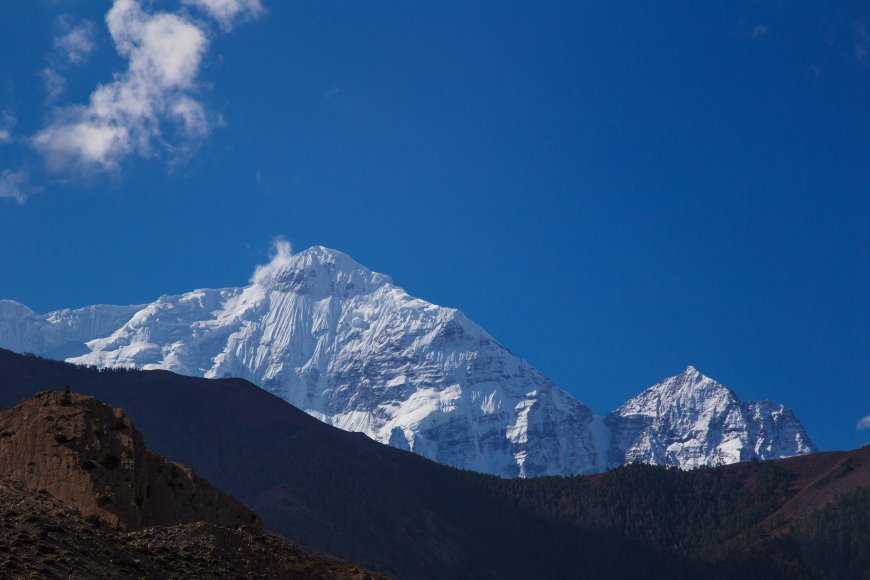
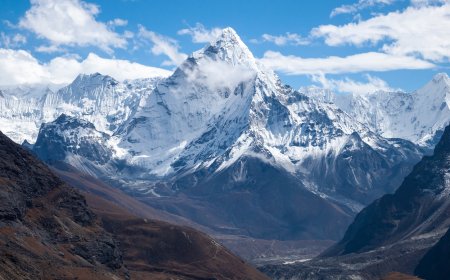
Ama Dablam sits in the Khumbu below Everest and above the village of Pangboche, and from most angles it looks less like a mountain than a piece of set design: a sharp white triangle with a hanging glacier pinned to its flank. The name is usually translated as 'mother's necklace', a reference to that glacier — the pendant slung below the summit. Published heights differ slightly between sources, usually somewhere in the region of 6,800 m, but the number matters less than the shape. The standard line, the Southwest Ridge, is short and steep, and almost all of it sits above 5,000 m.
That combination is what makes the peak interesting. It is not an 8,000er, and plenty of fit trekkers look at it and assume the step up is modest. Two things get harder at once, though. Your body has to adapt to thin air on a compressed schedule, and your hands have to be genuinely competent on fixed rope, because the rock steps and the upper ridge are not the place to learn to change over at an anchor. Acclimatisation sets the pace of the climb. It does not replace the skill.
The Southwest Ridge in plain terms
Base camp sits on the moraine below the peak's south-west flank, somewhere around 4,600 m depending on where a team pitches. From there the route climbs through a rocky step to Camp 1, continues up mixed ground to Camp 2 on a small shelf, then follows a long snow and ice slope to the high camp before the summit ridge. Numbers vary a little between operators, but the broad shape does not: Camp 1 near 5,800 m, Camp 2 close to 6,000 m, and a high camp above 6,200 m.
Above Camp 2 the angle steepens and exposure grows. Fixed rope covers most of the serious ground. The summit ridge narrows, corniced on one side, with the snow formations that give the peak its signature profile in every photograph. The hanging glacier above the route is a genuine objective hazard, which is why teams move briskly through certain sections instead of stopping to enjoy the view.
Why acclimatisation sets the pace, not fitness
Altitude illness is not a fitness problem. The body adapts to thin air by breathing faster, producing more red blood cells and adjusting the balance of acids in the blood, and it does all of that on a schedule nobody can negotiate with. Fit climbers get sick up high too. They simply tend to hide it better, until they don't.
On Ama Dablam the adaptation problem is compressed. You start comparatively low at base camp, gain height quickly on the ridge, and the summit push leaves very little room for a bad night. That is why nearly every team builds time elsewhere in the Khumbu first: a slow walk in on the Everest Base Camp trail, a night or two around Dingboche or Chhukung, an easier summit such as Lobuche East or Pokalde, and only then the move to Ama Dablam base camp. None of it is glamorous. All of it is the point.
How the rotations usually work
Once at base camp, the pattern most teams follow is climb high, sleep low. A first rotation carries a load to Camp 1 and returns to base the same day. A second goes to Camp 2, sometimes with a night there, then descends again. The purpose is not to rehearse the summit. It is to bank the time at altitude that makes the summit push survivable, and to test how your body behaves before you are committed high on the ridge.
Teams that cut rotations to save days often spend those days anyway, waiting out headaches at base camp or walking down. That is a worse trade. A schedule with no slack is a schedule the weather will break for you.
When people actually climb it
Almost all ascents fall into two windows: spring before the monsoon, roughly April into May, and autumn after it, roughly late September through November. Autumn is generally the busier of the two, with settled weather and firmer snow up high. Spring brings longer days and a deeper snowpack, and the weather can swing harder. Neither window comes with a guarantee. Teams get turned around in both, and a good season is usually one where the schedule still had room to wait.
Permit rules, royalty fees and what operators require of clients on this peak do get revised, so confirm the current position with your operator and the relevant Nepali authorities rather than trusting figures in any blog post, this one included.
What the fixed ropes change, and what they don't
Ama Dablam is climbed largely on fixed rope, which shifts the risk profile in ways worth understanding before you pay a deposit. It makes steep ground manageable for a fit climber with solid jumar and abseil skills. It also means you move at the speed of the queue, that you trust anchors someone else placed, and that your own handling of a mechanical ascender and a belay device stops being optional. Guides generally expect you to change over at an anchor, pass a knot and descend a rope under control without help.
So the honest description is neither 'easy because it's fixed' nor 'extreme because it's steep'. It is a high, steep, objectively hazardous route on which the rope makes the movement manageable while doing nothing at all about the altitude or the seracs.
What the ascent record is actually useful for
Sixty-odd years of ascents and a long accident record make the peak unusually well documented for its height, and that documentation is worth reading before you go rather than after. The useful part is not the summit list. It is the pattern behind the incidents, which in Himalayan climbing generally cluster on descent, in deteriorating weather, and among teams whose schedule has already slipped once. Read enough of those accounts and the decision to take an extra rest day starts to look less like laziness and more like judgement.
Questions worth asking before you commit
Ask an operator how many rest days are built into the schedule and what happens if the window closes early. Ask how many climbers each guide handles on the upper ridge, and what previous altitude experience they expect from you. Ask what the plan is when a team member is too slow to be safe, because that decision gets made on the mountain and it is better to hear the answer in Kathmandu.
What does not change from season to season is the shape of the problem. Ama Dablam rewards climbers who treat the waiting, the rotations and the rest days as part of the climb, and who arrive at the ridge with altitude already on their side and the ropework already in their hands.
What's Your Reaction?