






Who Records Your Flood Damage in Nepal? Tracing the Paper Trail From Ward Office to NDRRMA (2026)
A records-trail explainer on where a flood damage entry is opened in Nepal, who forwards it, and who keeps the copy — with the details we could not verify left as questions to ask locally.

Flood water goes down and the paperwork starts. That's the point where most households lose the thread, not because anyone refuses to write things down, but because the record of the damage gets opened in one office, copied in another, and forwarded somewhere else, and nobody hands you a tracking number at any stage.
This piece follows the record itself: who opens it, who carries it forward, who ends up holding a copy. It is not about amounts, eligibility or how to apply, and it promises no outcome. The "2026" in the title is the year this was written, not the name of a scheme or a package.
One caveat shapes everything below. While assembling this, we could not open and verify a single current official page for the ward, palika, district or national level in the same pass. Rather than guess at form names, register titles and counter hours, the parts we can't stand behind are written as questions to ask at your own office. Where a name would normally sit, you'll usually find a question instead.
The chain, as it is generally described
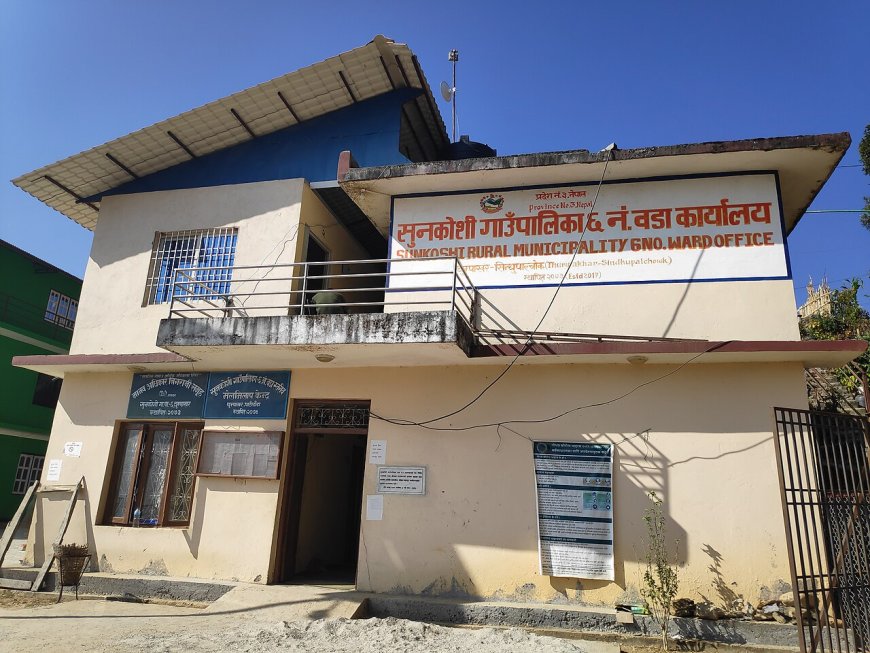
A flood damage report in Nepal is normally first raised at the ward office. That's the level closest to the house, staffed by people who know which settlement sits on the bank and which one floods every third monsoon. It is also where a spoken account either becomes a written one or doesn't.
Above the ward, the record is described as moving to the palika, where some arrangement is supposed to hold it. The name of that arrangement varies by local government. Some palikas will talk about a palika disaster management committee; others route the same work through a single focal person, or a section sitting under the chief administrative officer. Ask which one is in force where you live rather than assuming any version is universal.
Then comes the district-level office that receives what the palika forwards, and above that the national level, where the National Disaster Risk Reduction and Management Authority (NDRRMA) is the body named in the country's disaster framework. What NDRRMA flood damage records actually look like at that altitude, and whether a particular household's entry ever reaches it, is exactly what nobody standing at a counter can see.
Why the trail is hard to follow
Three things make it slippery. First, the first report is often verbal, and a verbal report leaves no copy in your hand. Second, the copy count is uneven: the ward keeps one, the palika gets one, and the household frequently ends up with nothing, so the only evidence of what was recorded lives in somebody else's file. Third, the vocabulary isn't standard. A ward office flood damage listing in one palika may be filed under an entirely different heading twenty kilometres away, which makes it hard to ask for the right thing by name.
We are not aware of a public way for a household to look up its own entry after the fact, and that gap is worth asking about directly. If a register exists with your name in it, you should at least know what it is called and who can see it.
What to ask to be written down, and by whom
This part is within your control, and the questions are short enough that any clerk can answer them.
Ask the person taking your details to write their own name and designation beside the entry, along with the date. Ask what the entry is called in their file, the exact heading, and write that down yourself on the spot. Ask whether you can photograph the page or take a copy, and if the answer is no, ask why not. Ask who forwards it upward, to which office, and roughly when. Ask what happens if the forwarded copy never arrives. And ask for the name of the office at palika level that keeps the local copy, because "the palika" is rarely specific enough when you have to go back a second time.
If you started with a search like "disaster relief Nepal which office", the honest answer is the ward first, then the palika, and the names will differ from district to district. There is no single national answer that fits every local government.
What this piece is not
It is not legal advice, it says nothing about whether you qualify for anything, and it makes no promise that a record leads to a payment. It is a map of where a piece of paper is said to go. Office names, forms and requirements do change, sometimes between one monsoon and the next, so the practical rule is to confirm locally before relying on any of it.
Last checked: 26 November 2026. If your ward tells you the entry is called something we haven't described, that isn't a contradiction. It is the normal state of affairs, and it is the reason the record is worth chasing in person rather than assuming.
What's Your Reaction?