










Fertiliser Subsidy in Nepal: How the Urea and DAP Quota Chain Works, and Where to Check the Official Price
Who imports subsidised urea and DAP in Nepal, who fixes the rate, and how to check the official fertiliser price on the notice before you pay.

Two farmers can pay different amounts for what looks like the same bag of urea and both be within the rules. The number on the bag is not the number that decides anything. The rate notice for the season does. A subsidised rate for urea and for DAP is fixed by government notice each year, and it is revised, sometimes more than once. So the honest answer to "what is the price today" is: whatever this season's notice says, and here is who handles the bag before it reaches you and where to read that notice yourself.
This was written in late October 2026, which falls inside fiscal year 2083/84 BS, running from mid-July 2026 to mid-July 2027. Treat every figure you read anywhere, including on this page, as belonging to a fiscal year. The structure below changes slowly. The numbers on the notice do not.
Who actually moves the bag
The fertiliser subsidy in Nepal is not a price list handed out to shops. It is a chain of allocations, and each link has a name and an office behind it.
The subsidised supply is imported. For years the import side has been handled by two public bodies, Agriculture Inputs Company Ltd (AICL) and Salt Trading Corporation (STC), working to volumes set in the annual budget by the Ministry of Agriculture and Livestock Development. Ask at your district office whether that is still the arrangement for 2083/84, because the split of responsibility between the two is exactly the sort of thing that gets reorganised between seasons.
Below the ministry sits the provincial ministry of agriculture, which receives a share of the national volume. Below that is the district-level body. Older signboards call it the District Agriculture Development Office, or DADO. After federalisation many districts operate as an Agriculture Knowledge Centre under the provincial ministry, and your palika (municipality or rural municipality) also has its own agriculture section. The label on the door varies by district. The counter is the same one.
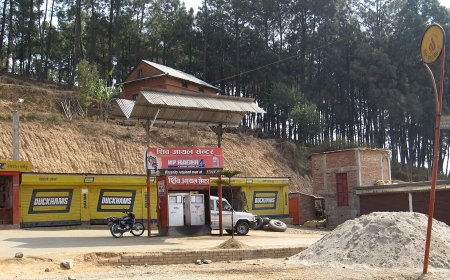
At the bottom, stock is issued through designated cooperatives and local agriculture offices rather than sold freely across shop counters. Everything past this point is local and it changes through the season, so the district office is the authority for it, not this page.
Step one: the annual import and allocation decision
How much urea and DAP comes in during a fiscal year, and how that volume is divided between provinces and districts, is decided at policy level and appears in budget documents and ministry notices. Nepal's fiscal year runs mid-July to mid-July, so the figures are tied to a specific year and go stale quickly. The current set belongs to 2083/84 BS.
Step two: the district split
Once the national volume is fixed it is divided down to districts, on the basis of cultivated area and expected demand. This is where most farmers lose the thread, because the district figure cannot be guessed from a national headline and is rarely announced loudly. It is, however, a written allocation, and you are entitled to ask what your district's share is.
Step three: the cooperative counter
Within the district, stock is held by designated cooperatives and issued against farmer lists. Which cooperative serves your ward, how much it was allotted, and whether that stock has physically arrived are three different questions with three different answers, and the third one changes week by week.
Step four: your entitlement
This is the link you control. Your allocation follows the landholding recorded in your name. If the record is old, incomplete, still in a parent's name, or held jointly over land that has since been divided, the quantity you are entitled to will not match what you farm. Sorting that out in the quiet months is far easier than arguing about it at planting time.
What to bring to the counter
In most districts the counter will ask for the land ownership certificate (lalpurja), a recommendation from your ward office, identification details, and your name on the cooperative's farmer list. That list is not identical from place to place and it does get revised, so phone the cooperative before you travel and ask what a farmer from your ward needs to bring this season. Turning up with the lalpurja and the ward recommendation is the safe minimum.
Where the price notice is published before you go
This is the part the title promised, so here it is properly. The subsidised retail rate is not secret. It is written down, and it can be read before you leave home.
AICL and STC both publish public notices, and their own websites carry the rate notices alongside them. District agriculture offices receive the same notice and post it on the office notice board. The cooperative holding the stock should have it displayed at the counter. Provincial ministries publish their allocation notices too. If you want a printed copy in your hand, the district notice board and the cooperative counter are the two reliable places. Websites are convenient but they are updated late, and what binds the seller is the notice in force on the day of sale, not the last thing posted online.
Four questions to ask at the counter
One. Ask to see the price notice for the stock in front of you. A written rate, not a figure from memory.
Two. Ask for the rate per kilogram, not only per sack. Bag weights differ, and a sack-to-sack comparison tells you nothing until the weight is written down.
Three. Ask for a receipt showing product, weight, rate, date and the name of the issuing body. A receipt without a weight is not much use to you a month later.
Four. If the amount charged differs from the notice, say so at the counter and ask for the difference to be explained. Write down the date, product, weight and what you were told. If the answer does not satisfy you, ask that office what the process is for raising a discrepancy. Do not act on hotline numbers forwarded on social media unless the office itself confirms them.
When the cooperative has no stock
This is the complaint that comes up most, and it deserves a straight answer rather than a shrug. Empty shelves are usually a timing problem, not a refusal. Stock moves from depot to district to cooperative in consignments, and a cooperative that was allotted 200 bags in Shrawan may have sold out by Kartik with the next lot still in transit.
So ask specific questions. Is my name on this season's allocation list for this cooperative? How much of the cooperative's quota has arrived, and how much has been issued? When is the next consignment due, and from which depot? If it will not arrive before your planting window, what is the written procedure? Put your demand in writing, get it dated and receipted, and keep a copy. A dated application is evidence. A conversation at the gate is not.
Is DAP subsidised on the same terms as urea?
Both products have featured in Nepal's subsidy arrangements, but they are different fertilisers with different supply routes, and the treatment of one has not always matched the treatment of the other. Whether both are covered this year, and on what basis, is precisely the detail that gets repeated wrongly in the market. Ask the office which products are covered before assuming your DAP entitlement mirrors your urea entitlement.
Why the same bag costs different amounts in different places
Comparing notes across districts and finding a gap is not automatically evidence of cheating. Distance from the depot matters. Timing matters, because stock arriving late in the season moves differently from stock arriving early. Local handling and bagging arrangements differ. And a bag bought outside the designated channel is not the same transaction as one issued against your recorded entitlement. None of this tells you what the correct rate is. Only the current notice does.
Two product facts worth knowing
Urea is 46 percent nitrogen. DAP is 18-46-0, meaning 18 percent nitrogen and 46 percent phosphate, and it is not interchangeable with potash. Those grades do not change with policy, so a bag that claims something else is worth questioning. Anything beyond that, including Nepali terminology on an official notice, ask the issuing office to explain rather than trusting a translation passed around at the market.
Where to confirm, every time
Your district agriculture office, and the cooperative holding your stock, are the only places that can tell you for your ward and this season what you are entitled to, where to collect it and what the current rate is. Everything above explains how the chain is built and how to check it yourself. The figures belong to the office, and to 2083/84 only.
For more on seasonal planting and farm inputs, see our agriculture coverage.
What's Your Reaction?