










Nepali Wedding Ceremonies: Rites and Guest Etiquette
A plain guide to Bahun, Chhetri and Newar weddings in Nepal: the rites they share, where those two traditions part ways, and what a guest should wear, do and give.

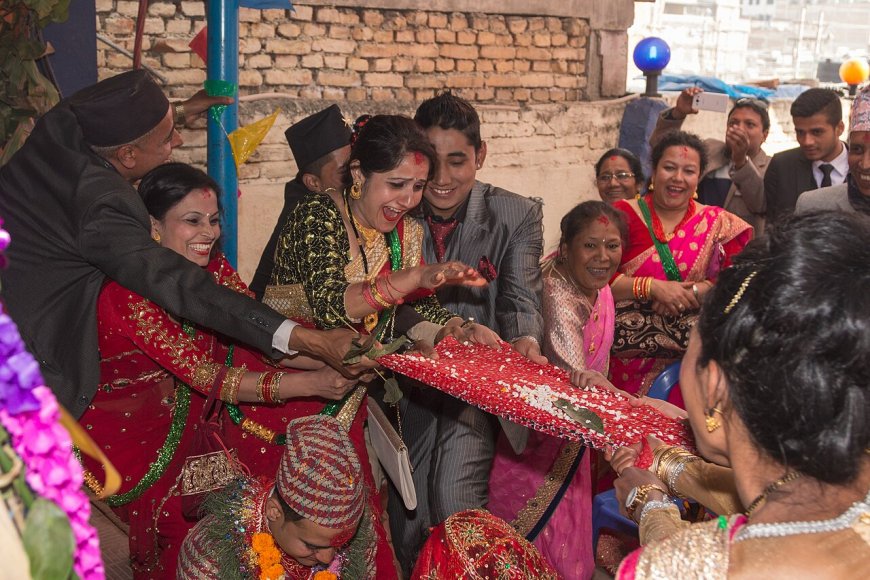
There is no single Nepali wedding. A Bahun household in Kathmandu, a Newar family in Patan and a Tharu family in Kailali will each tell you they had a proper Nepali wedding, and they will mean three quite different things. This page maps the beats that many Hindu Bahun and Chhetri weddings and many Newar weddings have in common, points out where those two strands part ways, and then gets to the part most readers are actually here for: what you, as a guest, are meant to do.
One warning before the list. What follows is a general pattern, not a rulebook. Priests differ from one another, families differ, and the same household may arrange things differently for a second daughter than it did for the first. Treat this as a map of the journey, and ask the family you're attending for the timetable.
The beats a lot of weddings share
Kundali milan, also called gun milan, is the oldest layer of the process. The couple's horoscopes are compared and their charts checked for compatibility. If the match looks workable, a priest is asked to fix the lagna: the auspicious date and hour at which the wedding should begin. Lagna is that fixed moment, not the matching itself, although in everyday Nepali speech people often say lagna when they mean the whole horoscope business. Plenty of couples now skip the astrology altogether and simply book a hall. Plenty of families still have a priest set the lagna, and the wedding date follows from it.
Sagun comes next in many households. A set of items, usually curd, beaten rice, fruit, sometimes a fish or an egg, is arranged, blessed and then shared. It works as blessing and as food at the same time, and you will meet versions of it across the whole ceremony.
Then the preparatory rites. Tel, the oil ceremony, has turmeric paste or oil applied to the bride, sometimes the groom too, in the days before the wedding. Mehendi, henna, goes on the bride's hands and increasingly on the groom's.
Janti, also called bariyat, is the groom's procession. Traditionally a walking march with a band, nowadays more often a convoy of decorated cars. At the bride's gate or hall entrance comes the dwar, where the arriving party is formally met and welcomed. In many versions someone from the bride's side blocks the way until a small courtesy or a joke is settled, and the mood shifts from procession to ceremony.
Then the vows themselves. Where kanyadaan is performed, the bride's family formally gives her away. The saptapadi, the seven steps taken together, is usually the heart of it: the couple walks seven steps, each one tied to a promise. Sindur, vermilion, is applied along the bride's hair parting. Afterward come tika and ashirwad, when elders mark the couple's foreheads with tika and offer blessings and gifts, and finally bidai, the bride's departure from her parents' home, which for many families is the emotional peak of the whole event.
Where Bahun/Chhetri and Newar weddings differ
A Bahun or Chhetri wedding is typically led by a pandit reciting Sanskrit mantras, with the sacred fire as witness and the sequence above running in more or less the order described. The bride commonly moves to the groom's household after bidai.
Newar weddings share several of those beats but not always their names or their order. The officiating priest may come from a Newar priestly lineage rather than a Bahun one. Much of the ritual is held at the bride's home rather than the groom's, and the running order tends to be shaped by kin-group obligations, by whose turn it is to host which feast, as much as by any printed schedule. The feasting itself is a serious part of the event and not an afterthought. Samay baji, beaten rice served with its set of accompanying sides, turns up at Newar feasts on ritual occasions.
Newar families also keep pre-wedding observances with no Bahun or Chhetri equivalent, ihi being the best known of them: a childhood rite that precedes a girl's marriage and is quite separate from it. That material deserves its own explanation rather than a paragraph bolted onto this one.
Other communities, briefly
This page does not cover Tharu, Janajati, Madhesi or Muslim weddings. Their ceremonies have their own logic and their own specialists, and nothing described above should be assumed to apply to them.
What a guest should do at a Nepali wedding
Dress: ask your host first. Smart and reasonably covered is the safe default, and temples usually expect shoulders covered and shoes off. Guests commonly wear a sari or kurta, men a daura suruwal or a shirt and trousers. If in doubt, err on the formal side.
Gifts: cash in an envelope is the commonest thing guests hand over in Nepal, and the amount swings wildly depending on how close you are to the family and what circle they move in. If you would rather bring an object, or you simply don't know them well, ask whoever invited you what would actually be useful. A wrapped present nobody needs is not better than a modest envelope.
The tika line: at many weddings guests file past the couple and elders to receive tika and give blessings, but whether guests join depends entirely on the family. At some ceremonies that part is for relatives and priests only. Ask a cousin or an uncle before you queue.
Photography: ask. Many families book a photographer and are delighted when guests take pictures too. Others treat the ritual moments as quiet ones. Temples may restrict cameras outright, and a phone raised at the wrong moment is the most common way guests cause offence.
Food: expect to be fed, repeatedly. Accept what's offered, and if you have dietary restrictions, mention them early rather than at the plate.
Declining politely is fine. A quiet word to your host, a small gift and a blessing offered in place of attendance goes a long way.
When the explanations conflict
They will. Three aunties will give you three versions of the same ritual, and all three will be partly right, because each is describing her own family's practice. Pick one person as your guide for the day, usually whoever invited you, and follow their lead. The only real authority on how a particular wedding is meant to go is the family holding it and the priest they've hired.
What's Your Reaction?