














Why Litter Ends Up on Everest: The Cost Calculation Behind the Rubbish
Everest litter is less a moral failing than a cost problem: at altitude, carrying rubbish out is expensive in weight, time and effort. Here's how deposit-and-return rules work, and where they break down.

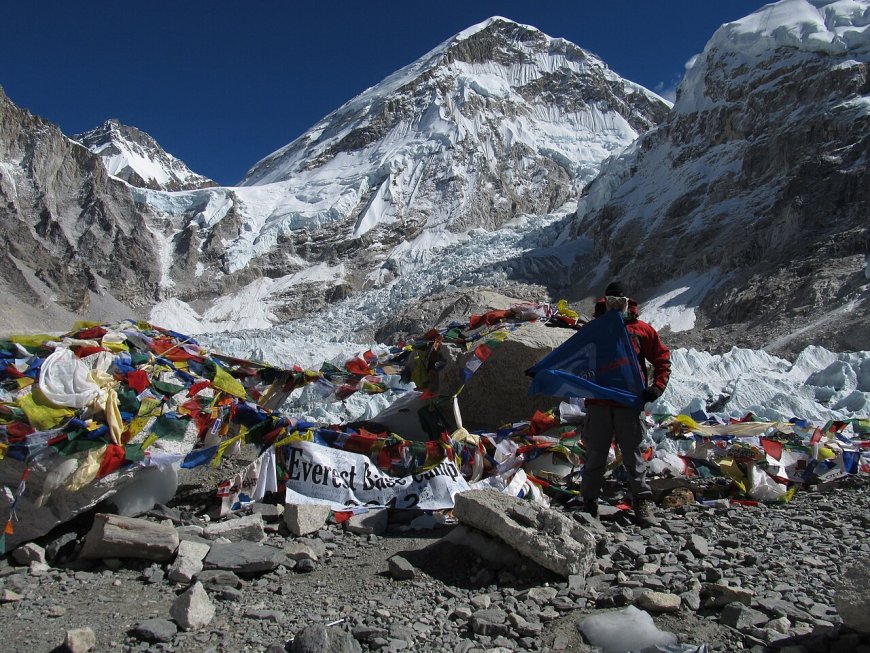
Every spring, as the Everest season builds, photographs of rubbish on the mountain do the rounds again. The story that follows is usually a simple one: selfish climbers, a sacred mountain turned dumping ground, somebody else left to clean up. It is a satisfying story. It is also a poor explanation of how litter actually gets left up there.
Litter on Sagarmatha is better understood as a cost problem. Above Base Camp, almost every action is a trade against weight, time, oxygen and risk. Carrying rubbish out loses that trade almost every time.
Almost nobody sets out to litter
An Everest expedition is expensive, long and physically miserable in ways most people never see. Someone who has spent that much money and that many weeks preparing rarely decides, sitting at home, to treat the mountain carelessly. What they decide, one tired moment at a time, is that the wrapper goes in the pack later. And later never comes.
The distinction matters for policy. If the problem were values, you would fix it with messaging. If the problem is cost, you fix it with prices, verification and convenience.
What littering actually costs at 5,000 metres
Start with weight. Every extra kilo above Base Camp is paid for in breaths, because the body is already working with less oxygen than it wants. Food, fuel and climbing hardware get calculated carefully. A climber up high is not thinking about the few grams of a wrapper. They are thinking about whether they have enough in the tank to reach the next fixed rope before the wind picks up.
The real cost is effort and attention. Stopping to open a pack, fight a zip, stow rubbish and get a glove back on is a cheap sequence at sea level. At altitude it is not cheap at all, and it has to be repeated dozens of times a day.
Then there is time. Weather windows are short and unpredictable. A morning spent sorting and hauling waste is a morning not spent acclimatising or waiting for an opening.
And then storage. What do you actually do with rubbish at a camp that has no bin, no collection vehicle and no space? Anything you keep, you carry. Anything you carry, you carry on the same legs where you are already exhausted.
Where enforcement actually bites
There are no inspectors at Camp Two. Whatever rules Nepal applies to expedition waste have to be enforced where people and loads can be counted: at Base Camp, on the trail, at the airstrip.
That gap between where waste is generated and where compliance is checked is the whole game. A rule that can only be tested on exit depends entirely on the exit check being consistent, measurable and hard to game.
Nepal's Everest waste arrangements rest on a mix of expedition conditions, the work of the Sagarmatha Pollution Control Committee in the Khumbu, and a deposit-and-return style requirement on expeditions. The details get revised. How much each member must bring back, where that weight is measured, what the deposit is and how much is refunded are not numbers I would repeat from memory, and they are not numbers any reader should take from a blog post without a date and a document behind them. For current figures, go to your expedition operator's permit paperwork or the authority that issued it. A number without a source and a month is decoration, not information.
Why deposit-and-return is clever, and fragile
The design is elegant. Put a price on the waste stream, then pay it back when the climber proves they carried their share down. It is the same logic as a bottle deposit, scaled up to a place where the return trip takes six weeks.
Three things break it. Measurement is the first: if the check happens far from where the waste was produced, what gets counted is whatever is easiest to present at the checkpoint, not the tonnage that actually came off the mountain. Size is the second: if the refund is small next to what carrying costs in effort, the deposit quietly becomes a fee people are happy to pay for not bothering. Gaming is the third, and any weight-based rule invites it. People optimise for the scale, not for the mountain.
What would actually shift behaviour
Make compliance cheap. Issue sturdy bags at Base Camp, put collection points where climbers already pass, and do the weigh-in at a queue they are standing in anyway.
Make the check boring and consistent. A rule applied firmly every season for a decade changes expectations. A rule that appears to relax after a bad news cycle does not.
Publish the money. If deposits go unrefunded, say where that revenue ends up and what it paid for. Transparency is the cheapest enforcement tool available.
And price it close to the real cost of carrying. If hauling a kilo down costs a climber more in effort than the refund is worth, no rule will hold above the Icefall.
For trekkers, the same arithmetic applies
Below Base Camp the numbers are smaller but the logic is identical. On trails with no collection system, whatever you carry in has to come out, and the teahouse trekker's version of the problem is a plastic bottle that weighs almost nothing at nine in the morning and a great deal by four in the afternoon.
Rules, fees and arrangements for Sagarmatha change. Anyone planning for the 2027 spring season should start from current official information rather than from older write-ups, including this one.
What's Your Reaction?