


Dashain Festival Nepal: How the Days Unfold, and What It Means for Travel
Dashain runs from Ghatasthapana, the first day of the bright half of Ashwin, to Kojagrat Purnima, the full moon that closes the month, and this article walks through each stage in order: the kalash and the jamara sown in a dark room, the quiet days that follow, the Fulpati procession of the navapatrika remembered from Gorkha, the worship of Kali and the blessing of tools on Ashtami and Navami, the tika and jamara of Vijaya Dashami, and the wind-down to the closing full moon. ...

Dashain is not one day, and treating it as one is where the confusion starts. It runs from the first day of the bright half of Ashwin to the full moon that closes the month, and each part of that stretch does something different. There is the grain sown in a dark room, the bundle of plants carried down from Gorkha, the red tika smeared across a family on the same morning. Visitors arrive expecting one enormous public holiday, then wonder why the shutters went down a week before anything seemed to be happening.
Below is how the festival unfolds, followed by what it does to offices, banks, buses and flights, and what it means for cash and errands. Those are separate questions with separate answers, which is why so many published Dashain lists go wrong: they mash the ritual calendar and the holiday list into one table and hope the two agree.
Ritual days and holiday lists are two different things
The ritual sequence comes from the Nepali almanac, the patro or panchang, which places each day by the moon. The days the government closes offices, banks and schools come from a holiday list issued separately for the year. They overlap, but they are not the same document, and they do not always match.
A lunar day can drift across a civil date. The holiday list decides which of the festival's days become days off, and whether extra days get attached to them. So the order below is the ritual order. The closures are handled on their own further down, because merging the two is how a lot of confidently wrong Dashain schedules get published.
The dates move every year. Ghatasthapana always falls on the first day of the bright half of Ashwin and the festival always closes on the full moon, but the Gregorian dates sitting under those lunar days change. Read the current year's patro and the current year's holiday list rather than a date you half-remember or saw forwarded on social media.
Ghatasthapana: the pot and the seed bed
Day one. A kalash, a water pot, is set up and worshipped, and jamara is sown in sand or soil in a dark, undisturbed room. Barley is the usual grain, though maize and wheat turn up too. The room stays closed to most of the household while the shoots grow pale yellow for want of light. Everything after this is dated from Ghatasthapana, which is why the day carries more weight than its quietness suggests.
The quiet stretch after Ghatasthapana
The days that follow, Dwitiya through Shashthi, carry no large public rite. This surprises people who expect the festival to be loud from the first morning. What actually happens is quieter and more practical: the jamara is watered and watched, households scattered across the country start moving home, city markets fill up, and new clothes get bought. Some districts hold local fairs and jatras in this window, but there is no single national observance to plan your week around.
If you are visiting, this is the part of Dashain that looks least like a festival and most like a country packing up to go somewhere.
Fulpati: the seventh day and the journey from Gorkha
Phul means flower, pati leaves. On the seventh day the navapatrika, a bundle of plants gathered for the ritual, is carried in procession. For a long stretch of Nepal's history that procession came from Gorkha, the old seat of the Shah kings, down to Kathmandu, where it was received with state ceremony before the bundle was taken on to the Dashain Ghar at Hanuman Dhoka. The procession is remembered as much for the journey as for the plants.
In most homes the day itself is quieter than the ceremony around it. Fulpati marks the point where the festival turns from preparation toward its main event.
Maha Ashtami: Kali, and the blessing of tools
The eighth day. Kali is worshipped in her fierce form, and tools, weapons and machinery are blessed. Animal sacrifice has historically been part of this day, and of Navami, in some temples and households. It is a ritual act, not the point of the festival, and it is not something this page illustrates.
Maha Navami: Vishwakarma, and the day calendars disagree about
The ninth day. The blessing of tools and machines is where published Dashain calendars visibly diverge. Many mark ayudha puja on Ashtami and Vishwakarma puja on Navami. Plenty of garages, workshops and transport operators do theirs across both days rather than pick one. In practice, buses, taxis, motorbikes and shop tools get garlanded and dabbed with tika somewhere in that stretch.
In Kathmandu, the Dashain observances at Hanuman Dhoka and the Taleju temple have long been tied to the official side of the festival, with worship there on Navami. The jamara is nearly ready by now.
Vijaya Dashami: tika, jamara and the day everyone means
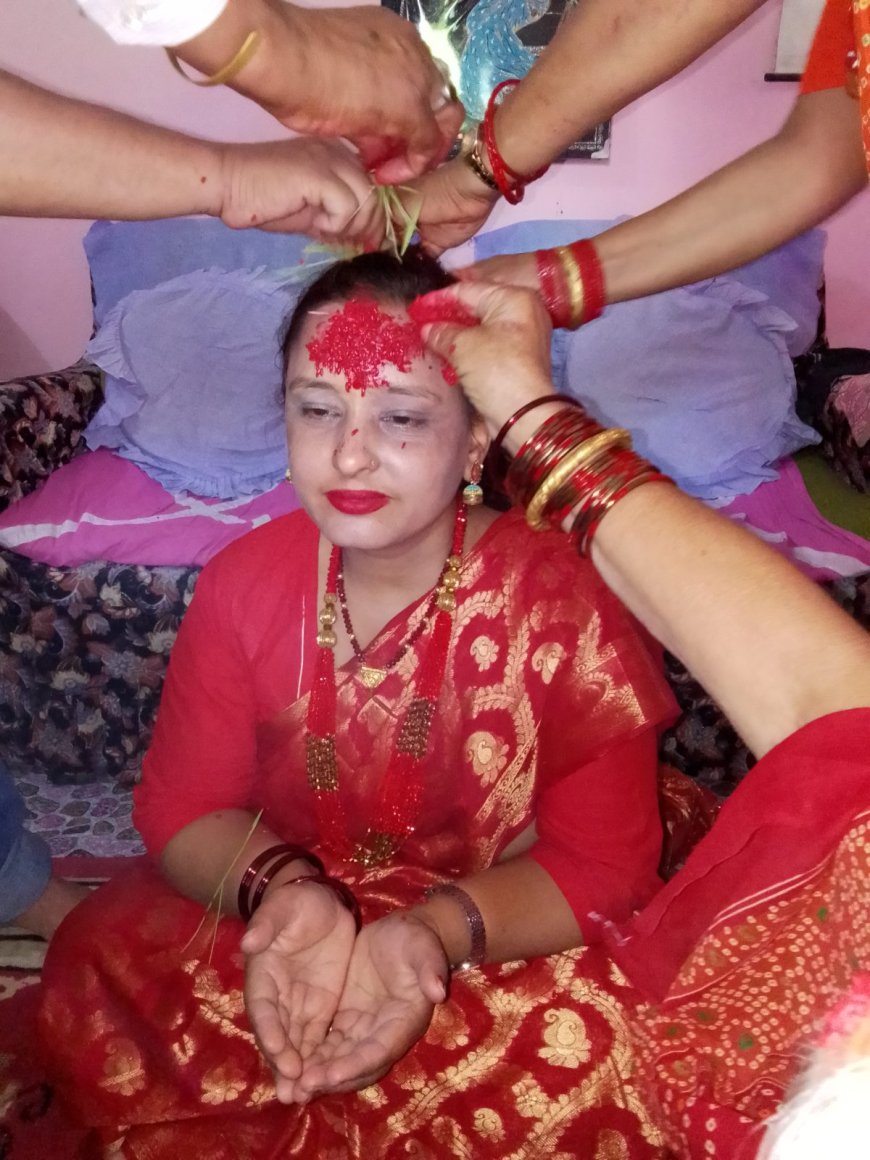
The tenth day, and the one people mean when they say Dashain. Elders give tika, jamara is placed behind the ear, and dakshina changes hands. Households move between relatives, sometimes across several towns in a single day, and the roads fill accordingly.
If you understand only one day of this festival, make it this one. The tika is also where the social side of Dashain sits. It is a family obligation as much as a religious rite, and people travel long distances mainly to be present for it.
After Dashami, and Kojagrat Purnima
The days following Dashami thin out. The tithis after it carry no fixed public rite. People travel back, offices reopen in stages, and the last of the holiday energy collects around the full moon of Ashwin. That full moon is Kojagrat Purnima, and it closes the festival. Lakshmi is worshipped, and households traditionally stay up late, often right through the night, with card games and music.
What closes: offices, banks and schools
Keep this separate from the ritual days, because the source is different. Public holidays around Dashain come from the government's holiday list for the year, and the number of days on it is not the same every year. Government offices shut for the block it names. Banks follow that list plus their own published branch notices, so branches close on the main days. Schools usually take a longer break than the official list requires. Private offices vary by employer, and some stay open with a skeleton staff.
The practical upshot: check the current year's list, and check your own bank branch and your own employer, rather than assuming last year's pattern holds.
Cash, errands and the last working day
Cash is the part people get wrong. Branch closure notices go up well in advance and digital payments keep working, but demand for physical cash rises sharply around the main days and ATM queues stretch. Withdraw what you need before the festival rather than counting on the machine nearest you being stocked when you want it.
If you are paying wages, rent or a supplier, note that the last working day before the closures is the one everyone else targets too, so transfers and cheque clearing bunch up against it. Nothing stops, but everything slows at the edges, and a payment that leaves your account on time can still land after the holiday.
Smaller things matter as well. Repairs, deliveries and paperwork that need a signature from an office tend to stall for the length of the closure, not just a day or two. If something has a deadline on the other side of Dashain, push it through before the shutdown rather than after.
Long-distance buses before and after Vijaya Dashami
Dashain travel has an outbound rush and a return rush, and they behave differently.
The outbound rush runs before Ghatasthapana and through the days after it. Long-distance buses out of Kathmandu toward the hills and the Terai fill early, because the point is to be home in time for the ritual days, not to leave after them. Return travel concentrates after Vijaya Dashami, and it is the tighter of the two, since everyone is working to the same loose deadline for getting back to work and school.
Reserved seats go first. When scheduled services sell out, extra vehicles are often put on and touts appear around the counters, so booking early during Dashain is less about saving money than about getting on a bus at all. If your plans are fixed, book while seats are still listed. If they are not, keep some slack in your dates and travel off the peak if you can.
Roads are their own story. Highways are busier in both directions, and a breakdown, a landslide on a hill highway or a checkpost queue that would cost you minutes in an ordinary month can cost you hours in this one. Build in more time than the distance suggests, carry water and something to eat, and do not put a long bus ride and a flight on the same day.
Domestic flights over the same window
Domestic flights tighten over the same period, especially on the busier trunk routes out of Kathmandu such as Pokhara, Biratnagar, Nepalgunj and Bhadrapur. The tail end of the festival is usually harder to fly than the start, because outbound travel spreads over more days than the return does.
Fares respond to demand and move every year, so plan around the pattern rather than a price you remember from a past trip. Confirm schedules close to your date as well, since airlines adjust frequency for the season, and weather in the hills can disrupt short sectors regardless of bookings. If a flight is the only way you can make a fixed appointment, book it early and keep a road option in mind.
If you are Nepali and living abroad
Nepali embassies and consulates abroad commonly close on a handful of Nepali festival days, announced in a notice at each mission, on top of the host country's own public holidays. Passport, visa and attestation services can pause for a few working days, and the queue afterwards is often worse than the pause itself. Check your own mission's notice rather than assuming a shared rule, because the list differs from post to post.
Travel from the Gulf, Malaysia, Korea, Australia, the UK and the US toward Kathmandu builds in the period before Dashami and reverses straight after. If you are booking for family reasons rather than holiday reasons, that window decides your fare.
The pattern holds, the dates do not
Ghatasthapana to Kojagrat Purnima runs the same way each year. Sow, carry, worship, tika, wind down. What moves is the calendar, because it is lunar, and what varies is which of those days the state closes and how long banks, offices and schools stay shut around them.
So the rule for anyone planning around Dashain is simple. Treat the ritual sequence as fixed. Take the holiday list from the current year, not from memory. Move your cash before the closures, book buses and flights as early as your plans allow, and treat the travel rush as a warning rather than a timetable.
See our guide to Nepal's public holidays for the closure side, and the Nepali festival calendar for how Dashain sits against the rest of the year.
What's Your Reaction?