







Goat Breeds in Nepal: Matching the Animal to Hill, Mountain and Terai Ground
A zone-by-zone guide to goat breeds in Nepal: Khari and Sinhal in the mid-hills, Chyangra in the high mountains, local and introduced breeds in the Terai. Covers where crossbreeding goes wrong and the five questions to answer before you buy an animal.

Most goat farming failures in Nepal begin before the animals arrive. A farmer in Jhapa buys a long-haired mountain buck because it looked impressive at the haat. A household in Humla spends scarce cash on an exotic cross because the cross was sold as double the weight. Neither animal is bad. Neither belongs where it landed.
Breed choice is a matching exercise. The animal, the climate, the feed your own land already produces, and what you actually plan to sell. Line those four up and a very ordinary goat will still pay its way. Get them wrong and the best breed on paper becomes the most expensive animal on the farm.
Which is why it is hard to rank the goat breeds in Nepal from best to worst. The ranking changes depending on which side of a ridge you farm.
Start with your zone, not with the breed
Nepal is usually split into three farming zones: the Terai plains, the mid-hills, and the high mountains. The lines between them are not clean. A south-facing slope can be warmer than a valley floor a few hundred metres lower, and a cold, wet pocket can sit inside an otherwise mild district. Treat any zone table as a working rule rather than an official classification, and let your own memory of last winter overrule it.
What matters more than the label is the daily reality. How hot the summer gets. How long the snow sits. How far the animals walk for browse. Whether your shed floor dries out by mid-morning or stays wet for three days after rain.
The hill middle: Khari and Sinhal
Khari is the small, compact hill goat most Nepali farm households already know. It is not a heavy animal, and that is exactly the point. Khari handles crop residue, kitchen waste, roadside grazing and forest browse reasonably well, which is what a smallholding actually has to offer. Lower mature weight means less meat per animal, but it also means a lower feed bill and fewer losses in a bad year. For a household that cannot buy concentrate every month, that trade is usually the right one.
One caution, though. Plenty of goats sold as Khari at hill haats are already part-crossed, and the seller may not know it himself. Ask to see the dam if she is on the same farm. If nobody can show you the mother, treat "pure local" as a word rather than a fact.
Sinhal is the bigger hill option. It is generally described as longer-bodied, longer-haired and heavier than Khari, and it suits mid-hill ground where grazing is more generous and the winter is not severe. Farmers often say it finishes slower than a crossbreed but holds condition better when feed is short. If your land gives you more grass than cash, Sinhal deserves a serious look.
High ground: Chyangra
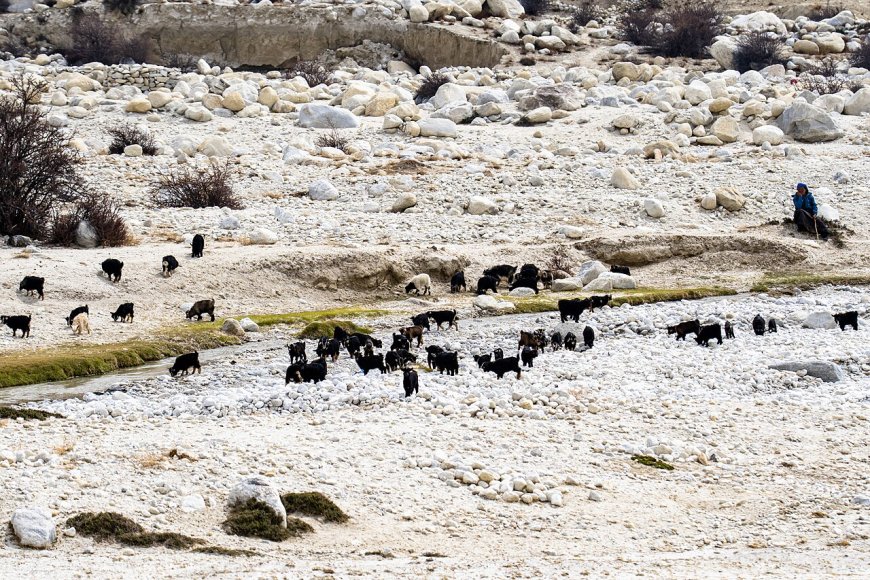
Chyangra belongs to the trans-Himalayan districts. It is the goat behind pashmina fibre, and it is built for cold, open grazing and long daily movement. Its value is not only meat. Pashmina is combed from the live animal once a year, so a decent doe or buck keeps producing a clip for several seasons before it ever goes to market, and good breeding stock is kept for years.
The catch is that Chyangra is a specialist. Heat and humidity treat it badly, it grows slowly, and the fibre needs combing, cleaning and a buyer who actually pays for it. Bringing Chyangra down to the plains, or into a humid river valley, tends to end with a thin, sick animal and a farmer who concludes that goats are not profitable. They were. That goat was simply in the wrong place.
Terai and the introduced breeds
Boer, the South African meat breed, turns up on many commercial Terai farms, usually as a cross rather than a pure animal. Boer crosses grow faster and dress out heavier, and that advantage is real. It is also a feed-dependent advantage. Put a Boer cross on the same scrub a Khari survives on and the growth gap narrows quickly, while the medicine bill does not.
Before the imports, there was the local Terai goat. A plain, short-haired, non-descript animal with no breed name and no stud book, and almost nobody writes about it. It handles heat, humidity and a crowded shed better than anything brought in from outside. It will not post the weights a Boer cross does, and it does not need to. The trouble is that it looks unremarkable, and unremarkable animals get sold cheap and then undervalued by the same buyers who paid extra for a longer coat.
Sirohi, Jamunapari, Beetal and Barbari are Indian breeds that have come into the Terai and inner plains over the years, often as crossbred stock. Broadly speaking, Jamunapari and Beetal are the taller, dairy-influenced animals, Sirohi is a hardy dual-purpose breed from Rajasthan kept for meat as well as milk, and Barbari is the small one whose size makes it popular with households that keep goats in a shed rather than on open range. Those are general descriptions. Individual animals vary enormously, and a badly reared specimen of a good breed is still a bad buy.
Crossbreeding goat breeds in Nepal, and where it usually goes wrong
Crossbreeding is not the problem. Doing it without a plan is.
- Grading up too fast. Replace too much local blood in two or three generations and the hardiness goes first, while the feed requirement climbs.
- One buck for the whole village. Repeated mating of related animals pulls down kidding rates and kid vigour. Rotate or exchange bucks, and write down which buck served which doe.
- Buying on appearance. Coat colour and size at the haat tell you less than the dam's history, the birth date, and how the animal has grown since.
- No records. Without a simple register of dam, sire, birth date and weight at fixed intervals, you cannot tell which line is working on your farm and which one is quietly losing money.
- Mismatch with the shed. A fast-growing cross in a damp, low-roofed shed will spend its weight gain on coughing.
Five questions before you hand over the money
Ask these honestly, and write the answers down.
- What does my land produce free of cost, and for how many months of the year? Three months of grass and nine months of buying is a small-animal budget, not a fast-growing one.
- What does this animal need that I will have to buy? Concentrate, minerals, medicine, and the fare to fetch them.
- How does it cope with my worst month rather than my best? Not the flush monsoon. The tail end of winter, or the week before the rains break.
- Who buys what I am selling, and how far away are they? A buyer four hours down the road changes the maths on a heavy animal.
- Do I know its dam, its birth date, and whether it has been bred before? If the seller cannot answer, price it as an unknown.
No breed fixes a feed gap or a wet floor. Pick the animal that fits what you already have, keep records for two years, and only then start experimenting with crosses. The farm that matches its breed to its ground usually beats the farm that buys the most expensive goat at the haat.
What's Your Reaction?