







Lhotse (8,516 m), Nepal: Why the World's Fourth-Highest Peak Is Rarely Climbed Alone
Lhotse, Nepal's 8,516 m peak, is the world's fourth-highest mountain but is rarely climbed alone. Its geography, first ascent and winter history.

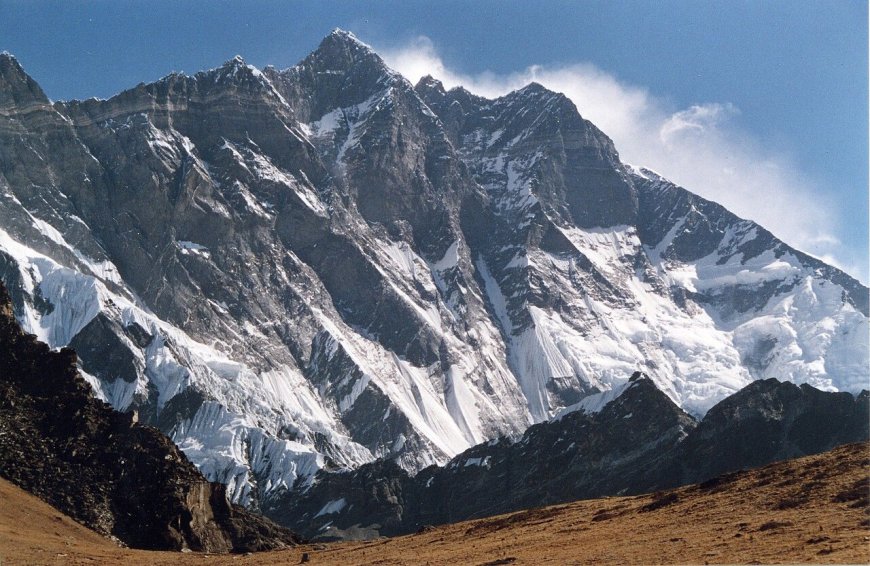
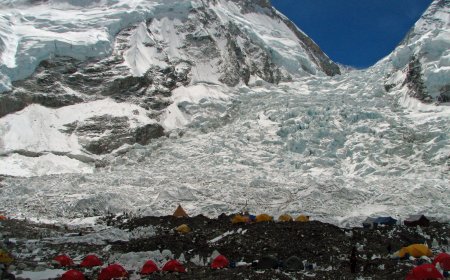
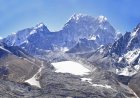
Ask someone to name the fourth-highest mountain on Earth and you will usually get a pause. Lhotse is the answer, and the pause is the point. At 8,516 m it stands in Nepal's Khumbu region, on the border with China, and by height alone it belongs in the very small group of mountains above 8,500 m. By reputation it belongs somewhere else: in the shadow of the peak next door.
What follows is background on the mountain. Its geography, the story of its first ascent, the winter climb that stands apart in its history, and the reason it is so often written about as an appendage to Everest.
A name, a border, and 610 short metres
The name is commonly glossed as "south peak", from lho, south, and tse, peak, which describes where it stands relative to its taller neighbour. Two subsidiary summits appear in the literature as well: Lhotse Shar, commonly cited at around 8,383 m, and Lhotse Middle, commonly cited at around 8,414 m.
Then there is the number that shapes almost everything else about how the mountain is understood. Lhotse's topographic prominence is commonly cited at roughly 610 m. Prominence measures how far a summit stands clear of the highest ground linking it to a taller neighbour, and 610 m is a very small figure for a mountain this high. Lhotse and Everest are joined at the South Col, so in purely topographic terms Lhotse reads as a high point on Everest's extended massif rather than a fully independent mountain.
That one measurement explains a great deal. It explains why prominence-based lists of major summits treat Lhotse as subordinate to Everest while height-based lists of the eight-thousanders include it without argument; both treatments are defensible, and the tension between them is why Lhotse's status tends to get explained rather than assumed. It also explains the shape of nearly every expedition that goes near it. A mountain that offers only 610 m of its own ground above the saddle it shares with Everest is a different proposition from a peak that rises free on all sides, and the logistics follow from the geography rather than the other way round. Figures like these are commonly cited rather than surveyed absolutes, and they are best read that way.
1955, then 1956: one year short
The first ascent came on 18 May 1956, when Fritz Luchsinger and Ernst Reiss, members of a Swiss expedition, reached the summit. The Himalayan Database, which catalogues climbing activity in the Nepal Himalaya, records that ascent, and it records the attempt of the year before too. In 1955 an international expedition led by Norman Dyhrenfurth tried the mountain and turned back high on the Lhotse face, around 8,100 m.
A year separates failure from success, which is a short interval for an 8,000 m peak being climbed for the first time. The 1955 party got high on the face and no higher. A season later the Swiss team finished the job, which says something about how quickly the remaining problem gave way once someone committed to it. It is tempting to dress the two attempts up as a rivalry or a race. The record does not support that, and the sequence stands well enough on its own: one year short, then not short at all.
Why Lhotse is so often climbed with Everest
The South Col is the hinge of the whole arrangement. An expedition heading for the col from the Khumbu side is, for most of its length, on the same ground regardless of which of the two summits it eventually goes for. The lines part high on the mountain, near the col itself, and until that point the effort, the carry, the waiting and the weather are shared.
This is why climbing Lhotse alongside Everest became a long-established pattern rather than an exotic variant. Everest is the taller objective and the one that draws the expedition; Lhotse is close enough, and shares enough of the same approach and the same high camp, that adding it to the same trip becomes a question of time and condition rather than a second expedition from scratch. Everest supplies the reason a team is on that side of the mountain at all. Lhotse supplies the fork.
31 December 1988, and the winter tradition
Winter in the high Himalaya is another country. The jet stream sits lower, daylight is brief, and the mountain is largely empty of people, which is exactly what makes a winter ascent a separate tradition from a pre-monsoon one. Krzysztof Wielicki made the first winter ascent of Lhotse on 31 December 1988, solo. The date is part of it: the last day of the year, mid-winter, one climber moving alone above the col.
Winter ascents of 8,000 m peaks are rare in a way that has nothing to do with fashion, and the small number of people who have done them is a fact about the mountains as much as about the climbers. Wielicki's ascent belongs in the history of Lhotse for that reason. It is not a benchmark, and it is not a template.
What all of it leaves you with is a single idea. Lhotse is the fourth-highest mountain on Earth and is discussed mainly in its neighbour's shadow, and the reason is a figure of about 610 m. Read the mountain through that figure and its history, its naming and the company it keeps all start to make sense. This is background rather than a route plan, so anything specific about permits, seasons or operators should come from current official and operator sources.
What's Your Reaction?