



Wedding Gift Ideas for Nepali Weddings: What to Give at Each Ceremony
A practical guide to giving gifts at Nepali weddings, covering what happens at the tilak, sagai, wedding day and reception, how gifting changes with your relationship to the couple, why odd-numbered cash amounts are the convention, and how to send a gift from abroad. It deliberately avoids quoting fixed prices, since gold rates, tailoring costs and delivery charges all shift, and points readers to check current rates themselves.

If you have ever stood in a Kathmandu department store the night before a wedding, staring at rows of stainless steel pressure cookers and wondering whether the bride's aunt will think a toaster is auspicious, you already know Nepali wedding gifting has its own logic. The practice revolves around shagun — auspicious offerings, usually cash or specific items, given to mark life transitions. Anthropologists describe this as a reciprocal gift economy; the gist is simple: what you give signals your relationship to the couple and to their parents, and it gets remembered.
Tilak and sagai: two different ceremonies
People often confuse them. Tilak is when the bride's family visits the groom's home and applies a red tika on his forehead, presenting gifts — typically clothes, a watch, maybe a gold chain. Sagai (engagement) is the formal ring exchange, often later, sometimes combined. At the tilak you will see trays of dry fruits, sweets, and cash in odd-numbered denominations — 101, 501, 1,101 rupees. One common explanation: odd numbers cannot be divided evenly, so they symbolise unity. Sindoor and pote usually appear at the wedding itself, not the tilak.
How much goes into the envelope varies enormously by community, city and relationship. A colleague's engagement and a cousin's wedding are not the same occasion. Ask a relative who knows the family's circle before you decide, and treat any figure a friend quotes you as a starting point, not a rule.
Wedding day: the main ceremony
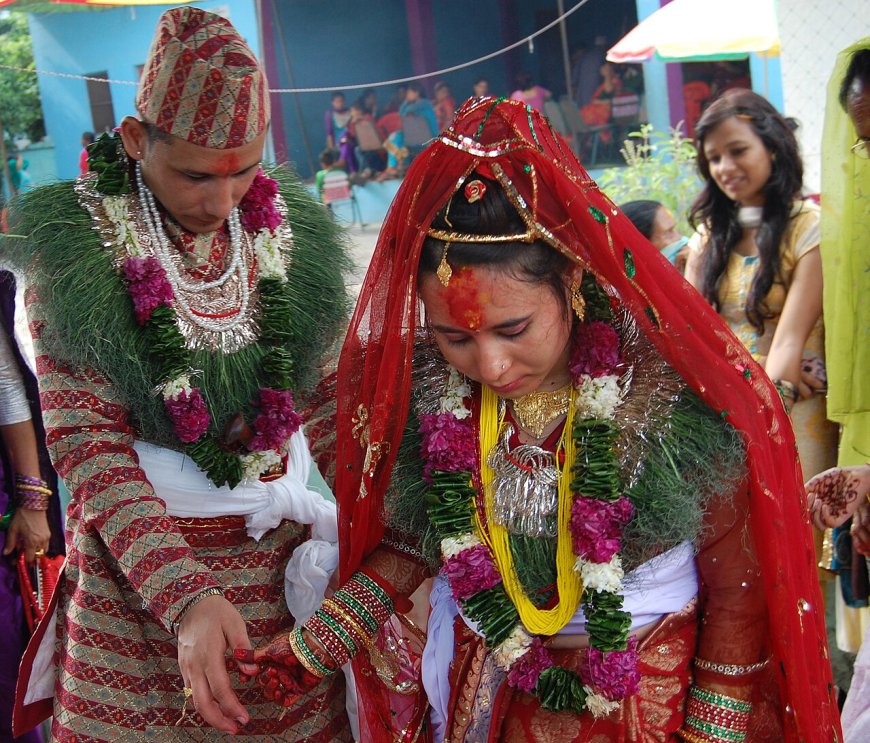
Gifts shift from the families to the couple. Close maternal uncles (mama) traditionally give gold — a tilhari or a set of bangles — while paternal aunts (phupu) may present a pote with a gold pendant. For guests who are not blood relatives, cash in an envelope remains the default, and mobile wallet transfers are now widely accepted at urban weddings. Keep the amount odd-numbered; that is the part people actually notice.
Reception: the public celebration
Receptions in hotels or banquet halls usually have a gift table, and many families display a QR code for wallet transfers as well. Some keep a ledger so every guest's name and amount can be recorded for future return gifts — reciprocity is how the system holds together. If you cannot attend, sending something beforehand through a local courier or delivery service is expected. Pick one that gives you tracking rather than an informal carrier.
Gift ideas by relationship
When the bride or groom is your sibling, the expectation rises. Brothers often buy a gold coin (one tola, 11.66 grams); check the Federation of Nepal Gold and Silver Dealers' Association daily rate on the day you buy, because it moves with the international market and the exchange rate. Sisters may receive a full tilhari set or a tailored kurta-suruwal from a local label — cost depends on fabric and tailoring, so work from the shop's current quote rather than a figure you remember from a few years ago. For parents, the gift is often practical: a pilgrimage to Muktinath or Janakpur, or simply paying for something they would never buy themselves. Travel agencies publish their own package rates and those change with fuel and season, so ask two or three for a written quote before you commit.
Sending gifts from abroad
Diaspora gifting has settled into a few reliable channels: direct bank transfer to the parents' account (mark "shagun" in the remark), a mobile wallet top-up using the recipient's phone number, or a delivery service that handles physical items. Shipping costs and customs treatment vary by country and by what you send, and gold and electronics draw the most scrutiny. If you want a hamper delivered inside Kathmandu Valley, order well ahead and confirm the service's current rate directly instead of trusting an old estimate.
Quick checklist
- Use odd numbers for cash — 101, 501, 1,101 or higher.
- Match the gift to the ceremony: tilak = trays from the bride's side; wedding day = gold or cash; reception = envelope or wallet transfer.
- For siblings and parents, think gold, a pilgrimage, or tailored clothing — not household appliances.
- If sending from abroad, use a service with tracking and confirm the rate before you pay.
- Keep a mental ledger. Reciprocity is not optional; it is how the system holds together.
You do not need to write the amount on the envelope, though some families appreciate it for their records. If cash feels awkward, a thoughtful item — a good Dhaka shawl, a brass kalash, a box of quality sweets — works fine for friends and colleagues. Foreign guests are not held to the same tiers; a modest envelope or a small gift from your home country is perfectly acceptable, and nobody audits it. The pressure cooker might still show up on the gift table. But knowing why the envelope matters more than the appliance makes the choosing easier.
What's Your Reaction?