



Khumbu Icefall: How Everest's Route Is Fixed Each Season
A look back at how the Khumbu Icefall route above Everest Base Camp was fixed in spring 2026: the ladder-and-rope engineering, the Icefall Doctors who build it, and why a fixed line is not the same as a safe one.

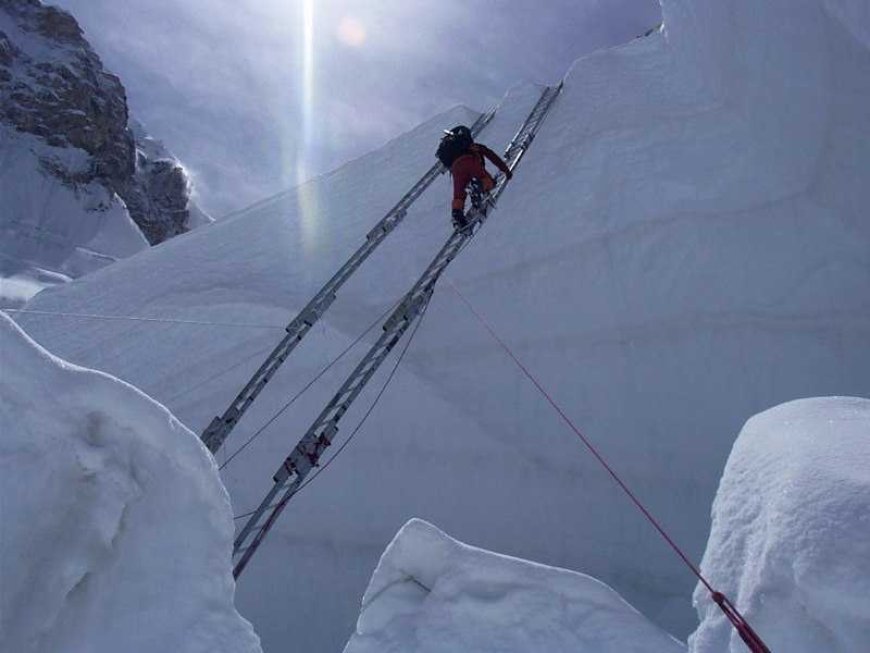
Before the first climbing team leaves Everest Base Camp each spring, someone else has already walked into the Khumbu Icefall and marked a way across it. A small Nepali team ropes the line, bridges open crevasses with aluminium ladders, and anchors the whole thing into ice that will not hold still. Through the season they patch it, re-anchor it, and move it. By the time most climbers see the route it looks permanent. It isn't.
What follows is a look back at how that work was done in spring 2026 and why the icefall has to be engineered at all. It was written in November 2026, after the season closed. Where we could not verify something, we left it out and say so at the end.
A moving floor, not a fixed pitch
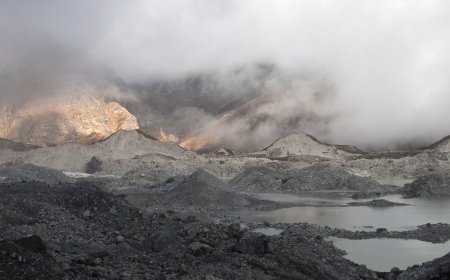
The icefall is the stretch of the Khumbu Glacier that spills out of the Western Cwm, the glacier's upper basin, and drops toward Base Camp. Ordinary valley glaciers creep. This one stumbles. The ice breaks into towers and blocks, and the gaps between them open and close as the mass shifts downhill.
That is the whole problem in one sentence: the map is out of date almost as soon as it is drawn. A route fixed early in spring 2026 was not the same route being climbed a few weeks later. Sections that were solid in March had shifted, sagged or opened up by the time the main teams arrived. The Icefall Doctors go back in and rebuild, sometimes more than once.
Who does the fixing
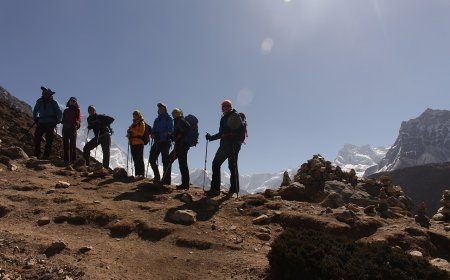
The team is known in the climbing world as the Icefall Doctors. They head in before the commercial expeditions, working the ground between Base Camp and Camp 1, and their job is to leave behind a continuous, anchored line: rope on snow stakes and ice screws, ladders laid across the wider cracks, fixed ropes where the surface is too broken to walk.
They are Nepali, mostly Sherpa, and they are hired for a specific skill set. Reading ice is part of it. Knowing where a slab is likely to shed and where it probably won't is part of it too, and that judgement does not come from a manual.
On the institutional side, the Sagarmatha Pollution Control Committee (SPCC), an NGO based in Namche Bazaar, has historically employed and organised the Icefall Doctors, working with government authorisation and alongside the local rural municipality. We could not re-confirm the current employment and funding arrangement from primary sources in late 2026, so treat that as historical context rather than a description of any particular season's contract.
Why the Icefall is dangerous
Seracs fall without warning. That's the short version, and it's the reason the route is treated as engineering work rather than a trail. A block of ice can shear off a wall above the line, drop, and send the debris across ground that was clear a minute earlier. Crevasses open under their own bridges. Ladders move when the ice they rest on moves.
In April 2014 a serac collapse in the icefall killed a group of Nepali workers, many of them carrying loads for expeditions, and a large number of teams ended their seasons early. It is still the event people reach for when they argue about who carries the risk on Everest, and it is why the route-fixing work is discussed as safety infrastructure rather than logistics.
Fixed is not the same as safe
What the route fix actually buys is a reduction in unknowns. It tells everyone where the crossings are, which ladders have been checked, and which line other people have already survived. It gives rescue teams a known location to work from.
It does not stop the ice. A crevasse bridged in March can be wider by May. A ladder that sat flat can end up tilted. And nothing about a fixed line changes what the serac above it is doing. Climbers still move through the icefall in the coldest hours, still cross quickly, still don't linger. The rope is a marked route, not a guarantee, and anyone treating it as one has misread the situation.
The labour behind the line
Here is something the route map doesn't show. Nepali guides and high-altitude workers move through the icefall considerably more often than the clients they support, partly because loads have to be ferried up ahead of each acclimatisation rotation. Some of those workers cross repeatedly in a single week.
That observation comes from how expeditions are organised, not from a count. No traffic figures for the icefall are published that we could verify, so we have not given a ratio, a percentage or a comparison of any kind. The point is simply that the fixed route is used by two very different groups of people at two very different frequencies, and the exposure is not evenly shared.
Medical support and evacuation
Two parts of the safety picture sit behind the route itself. The Himalayan Rescue Association has historically run a medical post at Base Camp during the spring season, and helicopter evacuation has long been part of the response to emergencies in the icefall and the Western Cwm, with long-line capability used where the terrain offers nowhere to land.
We could not confirm the 2026 arrangements from current sources, so this is background rather than a statement about what will be in place for spring 2027.
What this piece does not cover
No route-fixing fee, because no 2026-dated source could be verified. No figure for how fast the ice moves. No casualty total for the 2014 collapse, for the same reason. No traffic statistics, and no step-by-step description of how to cross the icefall, which would be neither accurate nor responsible in an article.
What it does cover is the shape of the thing. Each spring a small Nepali team rebuilds a route across a glacier that is actively breaking up, and several hundred people then use that route to reach Camp 1. Spring 2027 will follow the same pattern, and the work will look much the same as it did in 2026.
Sourcing and methodology note: researched November 2026. Verified for this draft: the route-fixing mechanism and the general character of the icefall. Dropped for lack of a verifiable current source: fee arrangements, glacier velocity figures, traffic comparisons, casualty totals, and the 2026 status of medical and evacuation services. Institutional roles are described as historical context only.
What's Your Reaction?