


Cho Oyu vs Everest: Which Is Harder, and Harder for Whom?
A practical comparison of Cho Oyu (8,188 m) and Everest (8,849 m) that breaks down difficulty into altitude exposure, technical terrain, and expedition logistics, then matches each profile — first 8,000 m climber, strong alpinist new to extreme altitude, and seasoned high‑altitude veteran — to the mountain that fits their real weakness. Includes key landmarks, crowding on Everest, and internal links for deeper reading.

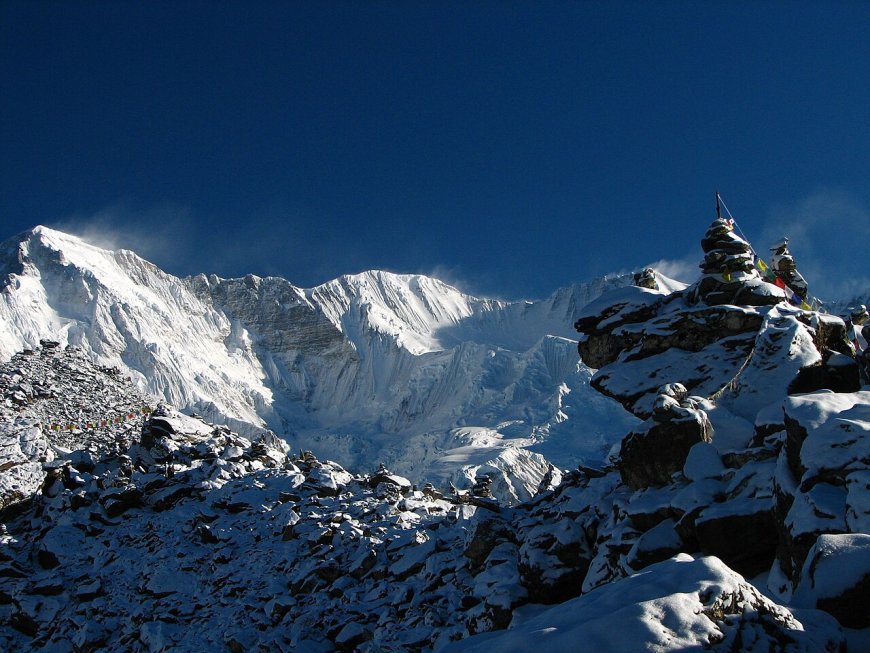
Everest is the harder mountain overall — higher, longer in the thin zone, heavier logistics, and more people in the way — but Cho Oyu is not the safe option, just the more forgiving one.
Put Cho Oyu vs Everest side by side and the question sounds like it has one answer. It doesn't. "Harder" is doing at least three different jobs in that sentence: harder on your body, harder on your technical skill, and harder on your patience, your calendar and your tolerance for sitting in a tent while the wind screams.
A mountain can be brutal on one of those dimensions and comparatively gentle on another. So the useful question isn't which one is harder in the abstract. It's which one is harder for the climber you actually are right now — your record, your skills, your window. Both are 8,000 m peaks. Both will punish a badly prepared attempt. The reasons they punish you differ.
Three ways one mountain can be harder than another
Altitude, and the hours you spend up there
Everest's summit sits at 8,849 m, Cho Oyu's at 8,188 m, and that single ordering does more work than any difficulty grade. High on an 8,000 m peak the body stops compensating for thin air. Acclimatisation slows, digestion suffers, sleep breaks into pieces, and everything — clipping a carabiner, melting water, pulling on a boot — costs more than it should.
The higher the summit, the longer the final stretch you spend in that zone, and the less margin you have when something goes wrong. Most of the Cho Oyu difficulty you'll hear described is altitude difficulty: a long, high, physically draining climb rather than a fiddly one. That is not a lesser problem for being simple. Altitude is the thing nobody fully trains their way out of, and it lands on the fittest person in the group as readily as on the slowest.
Technique and objective hazard
Technical difficulty and altitude difficulty are separable problems, and they hit different people. Technical difficulty is rehearsable: steep ice, rock steps, moving efficiently through exposed ground with a pack and a fixed rope. Objective hazard is a different animal. A crevasse field or a slope of seracs doesn't care how good you are. You can reduce your exposure to it. You cannot manage it away.
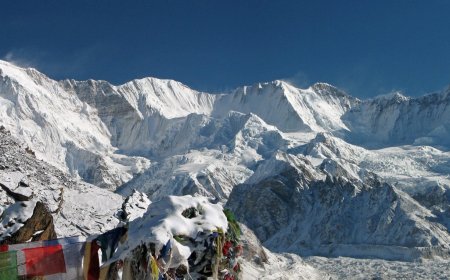
On Everest the technical crux is packed into a few short sections — the Khumbu Icefall, the Lhotse Face, the Hillary Step — with long, exposed, exhausting stretches between them. Cho Oyu's standard Northwest Ridge is generally less steep and less intricate, which is exactly why it gets recommended to people moving up a level. But a less demanding line is not a safe line. Seracs fall, crevasses open, weather arrives, and both mountains can kill a well‑prepared climber on a day that looked fine at breakfast.
Logistics and the commitment
The third factor is the one people underestimate from a desk at home. Days on the mountain, length of the approach, how remote the whole thing feels, and how much of the trip is spent waiting for weather rather than climbing.
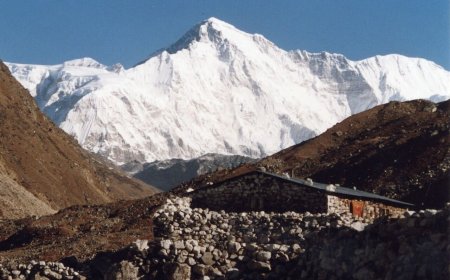
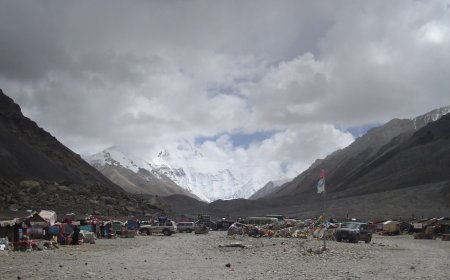
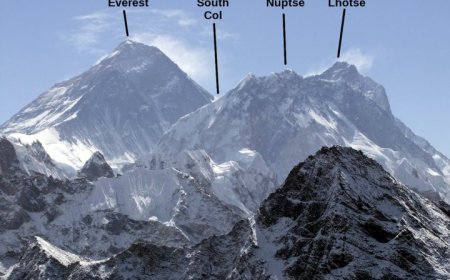
Everest (8,849 m) sits on the Nepal–Tibet border; the most common commercial route approaches from the Nepalese side via the South Col. Cho Oyu (8,188 m) lies on the same border, and its standard Northwest Ridge is usually reached from the Tibetan side. A long expedition is a slow accumulation of fatigue and small erosions: appetite, sleep, patience, the quality of your decisions. It also multiplies your exposure to weather. A higher summit generally means more of the schedule has to go into acclimatising and being in position, and that is time the mountain can take back at any point. Two climbers of equal ability can have completely different trips on the same mountain purely because one had a window and the other had a fortnight of wind.
Harder for whom
In the Cho Oyu vs Everest comparison, the answer depends on which of the three dimensions is your real weakness.
The climber with a solid 6,000 m record and no 8,000 m experience
For you, the wall is altitude, almost certainly. Your ropework is probably adequate, your fitness is probably fine, and neither of those is the thing that will end your summit bid. What will decide it is how your body behaves over successive days high on the mountain.
Everest is harder on this dimension, plainly, because it keeps you in the thin zone for longer with less room to be wrong. Cho Oyu gets suggested to climbers in your position, and the suggestion isn't absurd. Just remember that the mountain isn't grading your intentions. A first 8,000 m peak is still an 8,000 m peak, and treating the shorter schedule as a discount is how people get hurt.
The technically strong alpinist who has never been above 7,000 m
Your problem is the mirror image, and it can be more dangerous because you won't feel it coming. Hard moves you can solve. A body that refuses to acclimatise is not a problem you can solve with skill, technique or stubbornness.
You will probably find Cho Oyu's climbing undemanding relative to what you do at lower altitude. You will also, on either mountain, spend most of your time doing nothing technically interesting at all — breathing, resting, drinking, waiting. Climbers with your background often train the wrong half of the job. The altitude doesn't care how smooth your tool placements are, and no amount of competence protects you from a rock band coming apart above you or a serac releasing in the night.
The experienced high‑altitude climber with a fixed, limited window
You already know what altitude feels like and you've done the waiting before. For you the deciding factor is probably time: how much slack the trip has, how the schedule handles a bad week, whether you can afford to lose days and still be in position when the weather opens.
There's no universal answer here, only the fit between a mountain's rhythm and your calendar. A longer expedition gives more chances and takes more out of you. A shorter one is less forgiving of a single lost window. Be honest about how much of your decision is ambition and how much is the number of days you can actually take off.
Cho Oyu vs Everest: the verdict
Ask which of the three dimensions is your real weakness. Not the one you'd like to be tested on — the one that actually scares you a little when you're honest. If it's altitude, plan for the longer, slower exposure and stop pretending technique will cover it. If it's technical ground, get on steep ice and rock this season and find out whether you enjoy it, because the mountain will ask. If it's time, look at your window before you look at the mountain.
Then go and read more about climbing Everest and Cho Oyu themselves, not just their difficulty ratings, and check whether either fits the climber you'd be on the day.
What's Your Reaction?