


Everest vs K2: Which One Fits the Climber You Are
Everest and K2 sit in the same height bracket and demand completely different things from the person climbing them. A practical comparison of route character, permits on both the Nepali and Pakistani sides, and what the 2021 winter ascent changed, aimed at both guided clients on bottled oxygen and independent alpinists who want to lead their own pitches.

The short answer first, because the long one gets muddy. If you plan to climb with a guide, on bottled oxygen, clipped to fixed ropes somebody else put up, Everest is the more forgiving mountain and the better use of your money. If you lead your own pitches, carry your own risk and want a route that punishes mistakes instead of queueing them, K2 is the one. Everest vs K2 is not really a question about height. It is a question about which kind of climber you are, and the two answers point at different mountains.
Two summits, 238 metres apart
Everest stands at 8,848.86 m. That is the figure Nepal and China announced jointly in December 2020 after resurveying, and it replaced the older numbers still floating around in printed guidebooks.
K2 is usually listed at 8,611 m, which puts it roughly 238 m lower. On paper that gap looks like nothing. On the mountain it means almost nothing too, because the difference between the two is not vertical. It is the angle, the exposure, the retreat options and who is doing the work.
What Everest actually asks of you
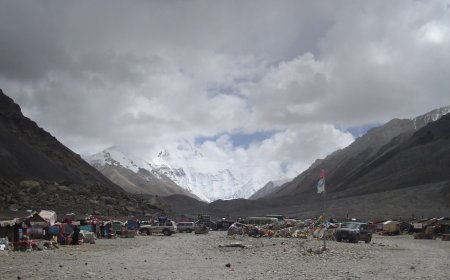
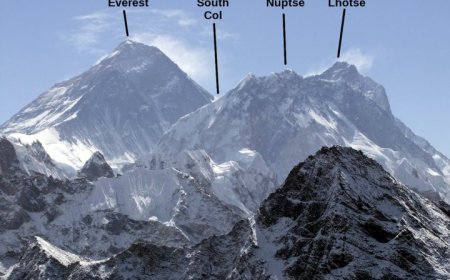
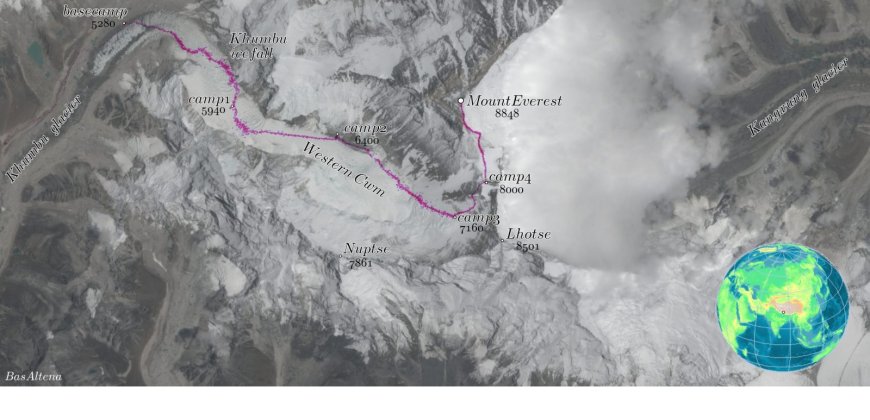
From the Nepal side the standard route runs through the Khumbu Icefall, across the Western Cwm, up the Lhotse Face to the South Col, then the Balcony, the South Summit and the summit ridge. Long. Cold. Very high for a very long time.
The technical climbing on that line is modest. Ladders and fixed ropes cover the icefall, and above camp two the route is largely a rope you clip through with a jumar. Guided teams fix the upper mountain and most clients climb on oxygen above 7,000 m or so. What is genuinely hard is altitude, weather, dehydration and the crowd on a good window. The mountain asks you to suffer well and to turn around when your guide says so.
What K2 asks instead
The Abruzzi Spur gives you House's Chimney, the Black Pyramid, then the Shoulder and the Bottleneck under the seracs. It is steeper, more sustained, and it mixes rock and ice in a way the Everest trade route does not. Very few people climb it on oxygen. There is no Sherpa rope team fixing the whole line ahead of you, and there is no helicopter coming if the weather turns.
Retreat is the part people underestimate. Coming down the Abruzzi from high on the route is slow, and a large share of the accidents on that mountain happen on the descent. Everest has a bad record too, but for different reasons: queues, oxygen failure, exhaustion on a long and forgiving-by-comparison line.
Permits, and why I am not quoting you a fee
Everest from Nepal means a climbing permit from the Department of Tourism in Kathmandu, a liaison officer, a rubbish deposit and Sagarmatha National Park entry. Royalties get revised, and Nepal has changed its Everest fees in recent years. Check the department's current published schedule for the season you are climbing rather than trusting a number on a blog, including any number I could put here today.
K2 sits in Gilgit-Baltistan, so the paperwork runs through Pakistani authorities and a licensed operator rather than Kathmandu. The approach from Skardu is a trek, not a flight to Lukla, and the season is shorter. Budget for a different country with a different process, and confirm current fees and rules with your operator before you commit a deposit.
The January 2021 winter ascent changed the conversation
On 16 January 2021 a team of ten Nepali climbers reached the summit of K2. It was the first winter ascent in the mountain's history, after decades of failed expeditions from some very strong Polish, Italian and international teams. Everest's first winter ascent goes back much further, to Krzysztof Wielicki and Leszek Cichy in February 1980.
That contrast is worth sitting with. Winter on K2 was considered close to impossible until quite recently. Winter on Everest is a known, if brutal, proposition. The two mountains are not in the same difficulty conversation, and the winter record makes that plain.
So: guided client or independent alpinist?
If you want the summit of the world's highest mountain and you are prepared to pay for the infrastructure that gets you there, Everest is the rational choice. You get fixed ropes, oxygen, a guide making decisions on your behalf, and a reasonable chance of standing on top if the weather cooperates. The compromise is that you are following, not deciding.
K2 rewards a different set of skills. You need to move efficiently on steep mixed ground, manage your own kit, and accept that the decision to turn around belongs to you and your small team. Clients do go to K2 with operators, but the margin for a passive participant is much thinner.
Here is the honest filter I would use. If you have never climbed above 7,000 m, or you are not confident leading on steep ice, book Everest with a reputable operator and treat it as the apprenticeship it is. If you already know how you perform at altitude on a technical route and you want the harder line, you knew you wanted K2 before you started reading this.
What's Your Reaction?